Overview
Goorm & Fintech Support Center · Mar–Jul 2026 · Content structuring · Learning UX · Web3
widigg is short for Whitepaper Digging, and was also the service domain (widigg.com).
Planned and built a beginner-friendly whitepaper learning web service. Then extended it with a Web3 feature that issues learning certification as an on-chain NFT.
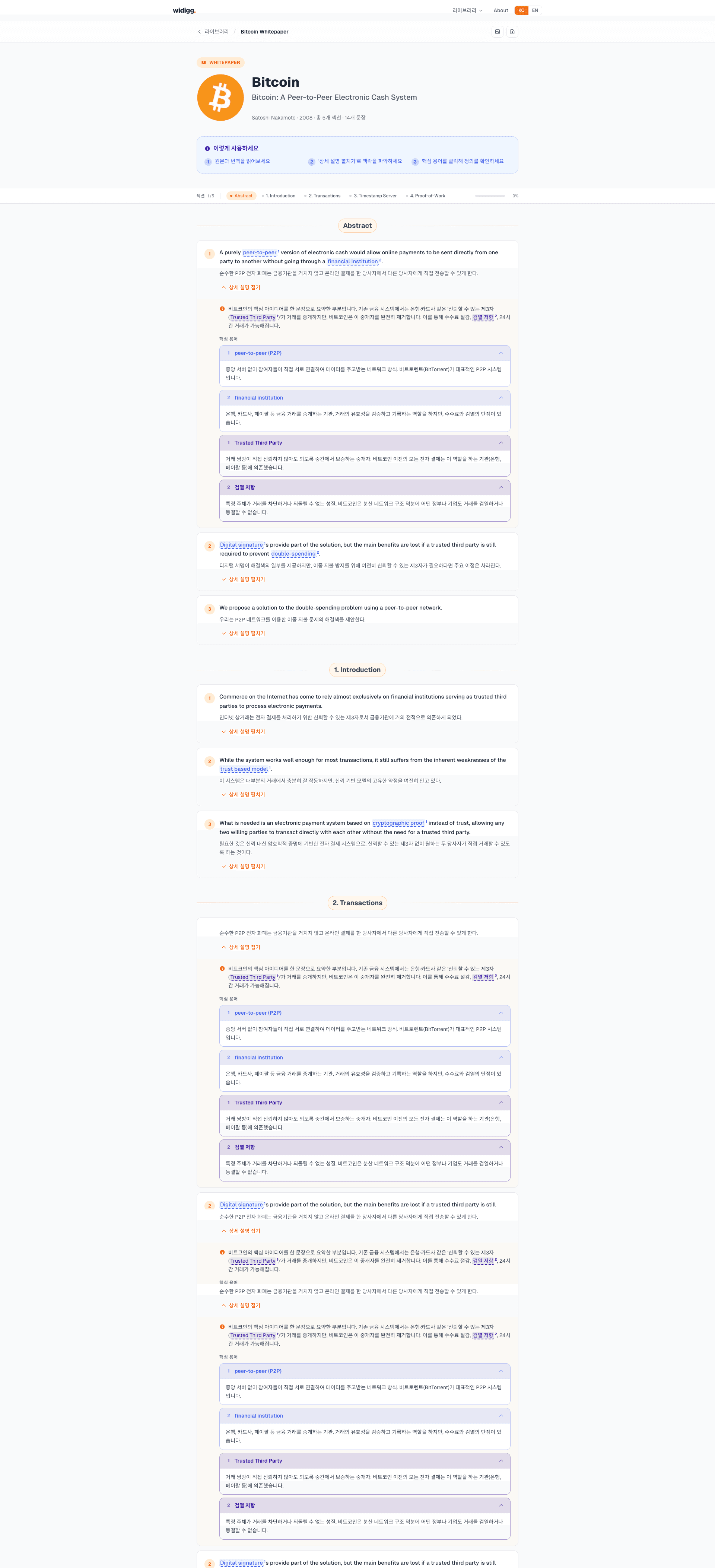
- Designed a 3-level accordion tree: source → translation → explanation → key terms
- Structured whitepapers sentence by sentence and integrated CoinGecko live prices
- Built cited Q&A (streaming), auto-generated quizzes, and a whitepaper→structured-JSON generation pipeline with Gemini
- On a perfect quiz score, an ERC-721 badge is minted for real on Base mainnet. The server must verify the pass via an EIP-712 voucher before issuance, metadata is fully on-chain, and a sharable OG card was added
- Built the front end myself, from price alerts (web push) down to image/PDF export
- Skill: information structuring/content design, learning UX, front-end implementation, LLM (Gemini) integration, smart-contract development, on-chain/off-chain architecture
- Stack: Next.js 16, TypeScript, Tailwind CSS, Google Gemini API, Solidity·OpenZeppelin·Hardhat, ethers.js·Base (L2), Firebase, Web Push·GitHub Actions
Problem
Crypto whitepapers are full of jargon and long sentences, so beginners struggle to read them. The source is hard to read directly, and translation alone fails to convey context and key terms.
Key point
Applied the progressive disclosure principle to the learning UX: reveal depth in stages rather than all at once.
- 1SourceThe whitepaper sentence as written
- 2TranslationSentence-by-sentence translation
- 3ExplanationContext translation alone misses
- 4Key termsJargon, unpacked
Solution
- Built a 3-level accordion tree that expands source → translation → explanation → key terms step by step
- Broke whitepapers into sentences so learners take them one at a time
- Added cited Q&A grounded only in the whitepaper (streaming) and auto-generated multiple-choice quizzes with Gemini. The sentence-level
idstructure is reused as the LLM citation anchor, jumping straight to the cited sentence - Ported wallet/Firebase modules from another project (project-EF) to mint an ERC-721 badge on a perfect quiz score. Answers are never exposed to the client. The server grades and issues an EIP-712 voucher signature, and the contract mints only with that signature. Badge image (SVG) and metadata are stored fully on-chain
- Sends a browser web push price alert when a target price is hit (checked every 15 min via a free scheduler)
- 1Take the quizAuto-generated multiple-choice quiz
- 2Server gradesAnswers never reach the client
- 3Voucher signedPerfect score earns an EIP-712 signature
- 4Badge mintedERC-721 mints only with that signature
Result
- Completed a structure that makes complex whitepapers learnable sentence by sentence, with KO/EN content generated by AI
- Extended static learning content into an interactive experience of questions and quizzes by adding Gemini
- Issues learning completion as a tamper-proof on-chain NFT certificate. Deployed the contract to Base mainnet, verified its source on Basescan and Sourcify, and completed real-mint E2E verification
- Connected Web2 (learning, AI) and Web3 (on-chain certification) in one service, and solved free-tier constraints such as gas-fee policy and cron limits with operations in mind
- Did everything myself, from planning through front-end and smart-contract implementation to Vercel deployment and operation
Retrospective
Unpacked difficult domain content with information structure and learning UX, turning reading into a learning process.
Added smart contracts and on-chain minting to a learning service. Designed and built a trustworthy issuance flow myself through signature-based server verification.
Built it directly with Next.js and Solidity, carrying the planning intent to the screen and on-chain without loss.
Links
- The standalone service finished development in July 2026 and was merged into the learning stage of COCOMSS
- COCOMSS was shut down on October 30, 2026