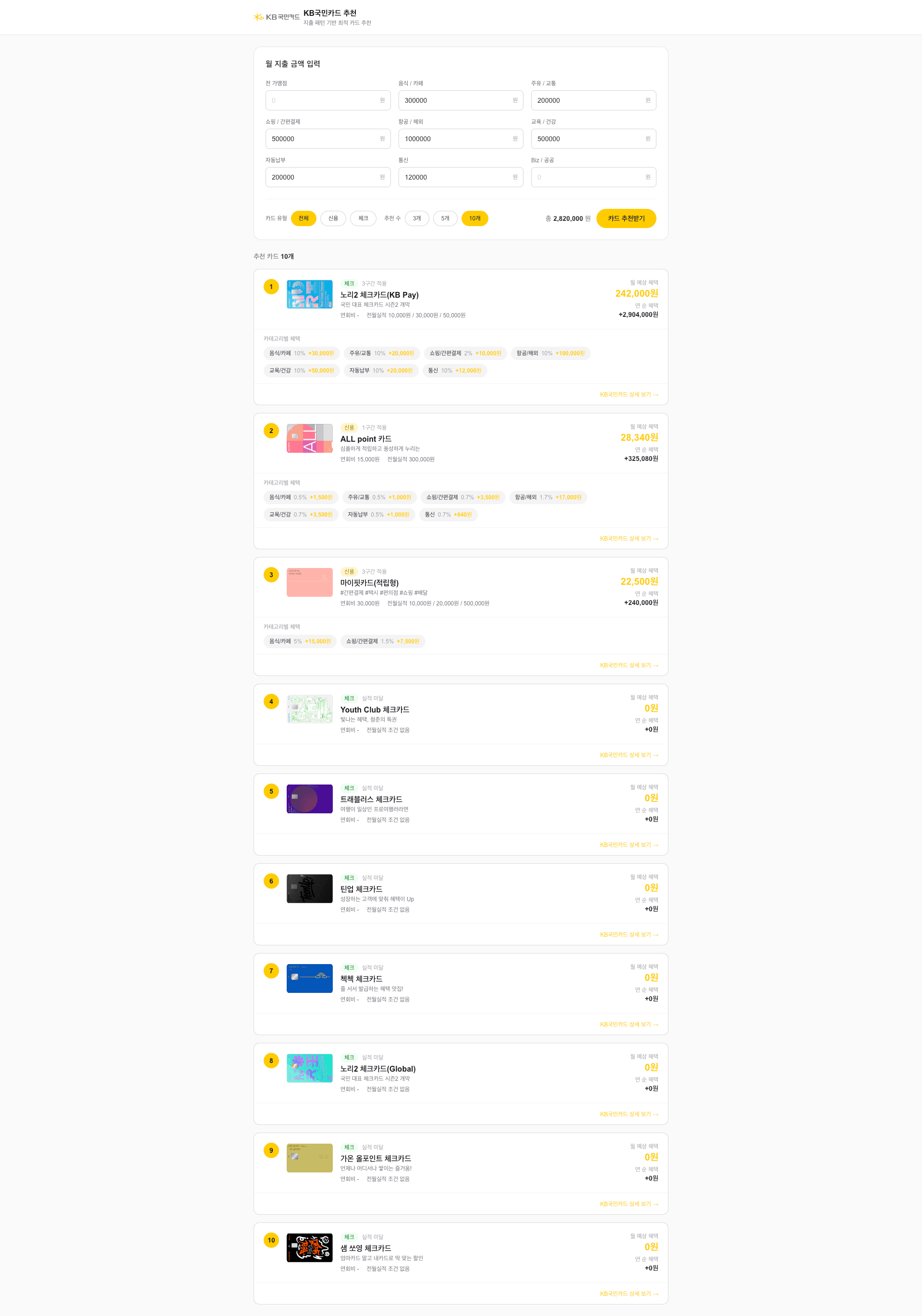
Overview
Goorm & Fintech Support Center · Apr 2026 · Full-stack build
Built a personalized 'KB Card Recommender' as a full-stack service driven by spending data.
- Crawled the KB Card site with Selenium·BS4 (105 credit + 23 check cards)
- Calculated benefits per spending tier and recommended by annual net benefit
- Full stack from crawling → MySQL → recommendation API → Next.js UI
- Designed a data pipeline with weekly auto-refresh via APScheduler
- Skill: data crawling/pipeline, rule-based recommendation engine, backend API (FastAPI), full-stack implementation
- Stack: Python·FastAPI, Selenium·BS4, MySQL·SQLAlchemy, pandas, Next.js·TS
Problem
Card benefits vary by prior-month spending tier, annual fee, and discount cap. It is hard for users to compare which card suits them best. A plain "popular cards" list doesn't match individual spending patterns.
Key point
Rule-based recommendation was given a net-benefit lens. Cards were recommended by annual net benefit (benefits minus annual fee), tailored to each person's spending.
Solution
- Collected data for 105 credit and 23 check cards with Selenium·BS4.
- Computed benefits per spending tier to derive the annual net benefit.
- Implemented the full stack from crawling to MySQL, the FastAPI recommendation API, and the Next.js UI, and added weekly auto-refresh.
- 1Data crawling105 credit + 23 check cards via Selenium·BS4
- 2MySQL storageStructured card data stored
- 3Net-benefit calcPer-tier benefits minus annual fee
- 4Recommendation APIFastAPI recommends by annual net benefit
- 5Next.js UIPersonalized picks for each user
Result
- Structured data for 128 credit and check cards.
- Completed a personalized recommendation logic based on annual net benefit.
- Built the full-stack pipeline from crawling→DB→API→UI with weekly auto-refresh.
| Type | Cards |
|---|---|
| Credit | 105 |
| Check | 23 |
| Total | 128 |
Retrospective
Designed and implemented the entire data flow myself, from crawling through DB and API to auto-refresh.
Distilled complex card benefits into the clear criterion of net benefit. This gave users a basis they can actually use for decisions.