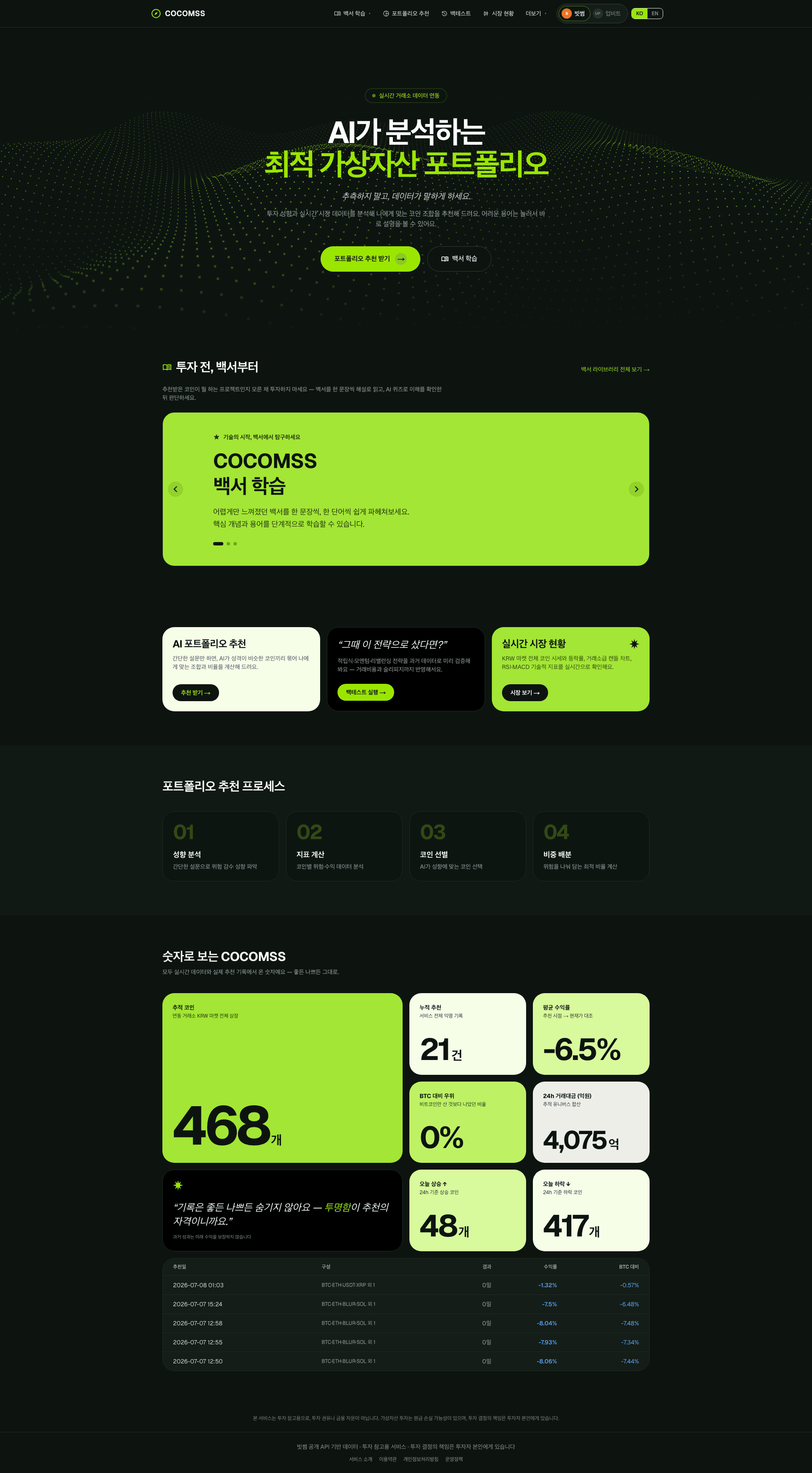
Overview
Personal project · Mar–Jul 2026 · Data planning · Full-stack · Exchange backend
COCOMSS was the service domain (cocomss.com) and is the name under which several projects merged. It began as a card recommender (KB Card) and pivoted to crypto. It then merged the methods of whitepaper learning (widigg), explainable AI (TrustFin), and equity research into one service.
Built a full-stack AI portfolio advisor that helps crypto beginners learn, understand, and verify before they put money into an asset they don't know. It is a technical demo with no real trading or fund movement.
- In the learn step, users study blockchain whitepapers in a 3-level tree (source→translation→explanation→terms). Gemini cited Q&A and quizzes are included, and completion earns an ERC-721 badge on Base mainnet
- In the understand step, a risk survey feeds K-Means clustering and Markowitz optimization to recommend a portfolio. XAI breaks the score into exact factor contributions so the sum equals the score, and "what if your profile were one step different?" counterfactuals are shown
- In the verify step, DCA/momentum/rebalancing backtests include fees, slippage, signal lag, and walk-forward. Bootstrap confidence intervals attach a "probability this result was luck"
- In the decide & practice step, learning-journey missions and a real-money-free paper portfolio track P&L
- For the exchange core, a service that only consumed prices gained a hand-built price-time-priority order book (CLOB) and double-entry ledger. The Rust high-frequency engine reaches a matching latency of p50 42ns. HMAC-signed orders, settlement, and custody state machines run in a sandbox
- Operations used a Bithumb/Upbit adapter toggle, live WS prices, zero-downtime rolling deploys (0 API/web failures), and CI with 4 jobs (191 pytest + Rust + Playwright E2E)
- Skill: data planning/recommendation, ML (K-Means)·quant (Markowitz·backtest), explainable AI, exchange backend (matching·settlement), full-stack·infra operations
- Stack: Python·FastAPI, scikit-learn·PyPortfolioOpt·pandas, Rust, Next.js 16·TS·Tailwind, MySQL·Docker·nginx·AWS EC2, Gemini·Solidity·Base
Problem
Crypto beginners easily invest off a recommendation without knowing what they are buying. Recommendations rarely explain why this coin. Backtests hide fees and luck behind good-looking numbers. To earn trust, the service needed a mechanism that tells you not to just trust the recommendation.
Key point
A learning buffer before investing makes people learn before they decide. Every number carries a "why" and a "chance it's luck."
Solution
- Designed learn→understand→verify→decide·practice as one flow and tracked each step with missions
- Modeled the score as a weighted sum of rules (60%) and ML cluster fit (40%) and broke each term's contribution down exactly, without approximation. Counterfactuals are derived by inverting thresholds from the formula and shown as they are
- Added trading costs, look-ahead prevention, and walk-forward to the backtests. Bootstrap reports the "probability of no edge over buy-and-hold"
- Enforced matching/settlement correctness (value conservation, no crossed book) with invariant tests. Dropped matching latency to nanoseconds in Rust
- Added a pre-use investment-responsibility consent modal and four legal docs (about, terms, privacy, policy)
Result
- Consolidated four prior projects (card recommender · widigg · TrustFin · equity research) into one journey-shaped service, run at cocomss.com until October 2026
- Made "why this recommendation" verifiable via XAI exact breakdown, counterfactuals, and an admin weight console
- The matching engine enforces invariants with 8-seed × thousands-of-orders fuzzing. The Rust engine recorded p50 42ns · 13.45M orders/s
- Zero-downtime deploys saw 0 failures across 542 API/web probes. CI ran 4 jobs green with 191 pytest + Rust + E2E
- Carried it from planning through backend, frontend, Rust, and infra, hands-on
Retrospective
Merged scattered experiments (card recommender, whitepaper learning, XAI, research) into a single product logic of "a learning buffer before investing." This time I learned that adding features and building a story are different jobs.
Published performance tracking, confidence intervals, and XAI breakdowns put "don't trust, verify" into code. I confirmed that this attitude matters most in a financial domain.
Built matching, settlement, and custody on top of a service that only consumed exchange prices. To the experience of building services in the exchange ecosystem, this added the experience of building exchange-core correctness. Real funds, regulation, and real-key custody were marked as out-of-code territory.
Links
- The service was shut down on October 30, 2026
- Merged from: KB Card Recommender · widigg whitepaper learning · TrustFin XAI · Stock Research
Screens — Learn: Blockchain Whitepaper Study
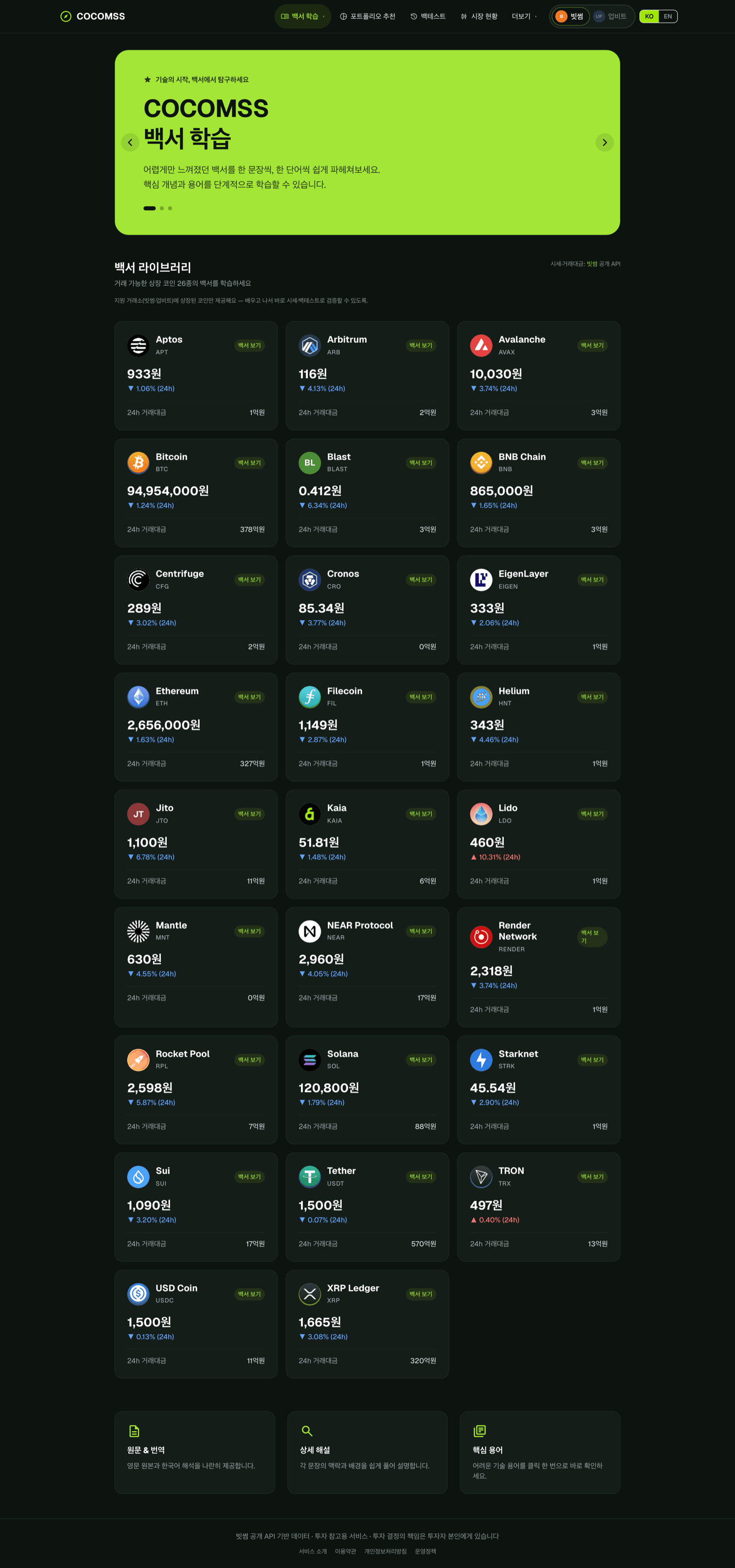
A 3-level whitepaper library (source→translation→explanation→terms) for the 26 coins listed on either exchange (Bithumb∨Upbit) out of a 45-doc catalog. Untradeable coins and non-coin tech papers are kept out of the journey. Live prices come from the exchange adapter. After learning, users can verify right away against prices and backtests.
Screens — Understand: Explainable Portfolio Recommendation
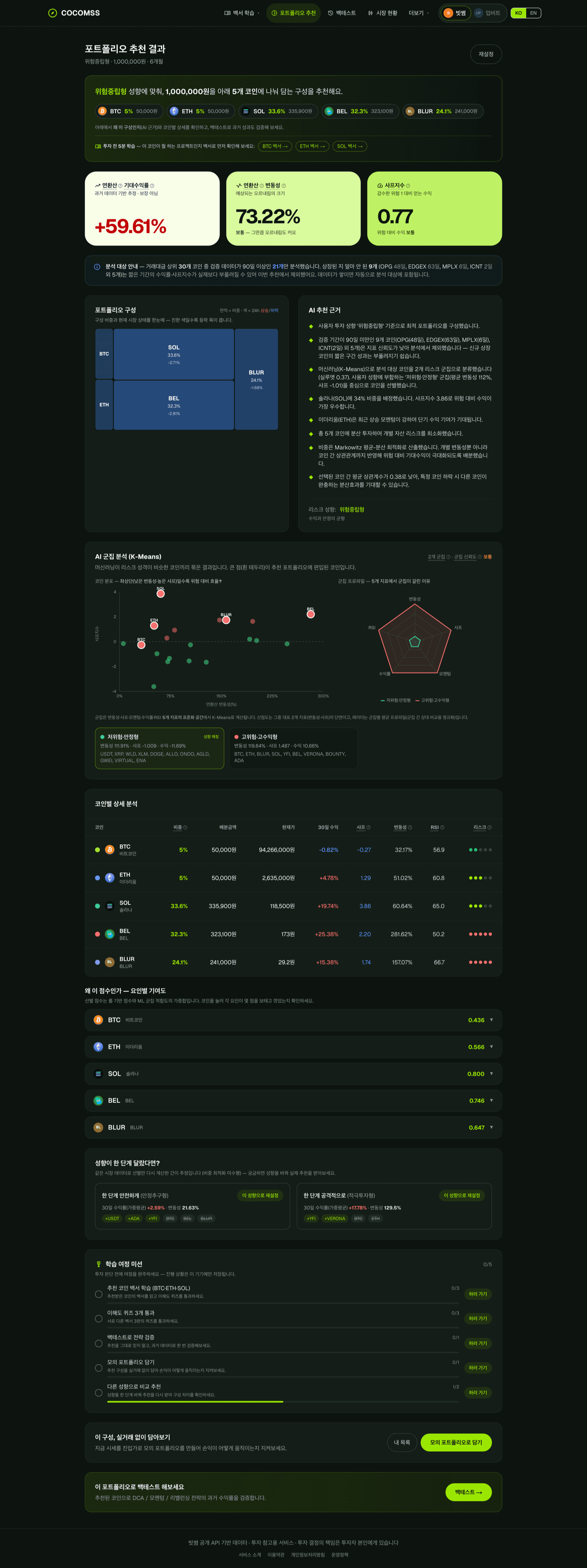
A risk survey feeds K-Means clustering and Markowitz optimization to recommend a portfolio. "Why this score" is broken into exact factor contributions so the sum equals the score. One screen holds a cluster scatter/radar, per-coin metrics, and "what if your profile were one step different?" counterfactuals.
Screens — Verify: Honest Backtesting
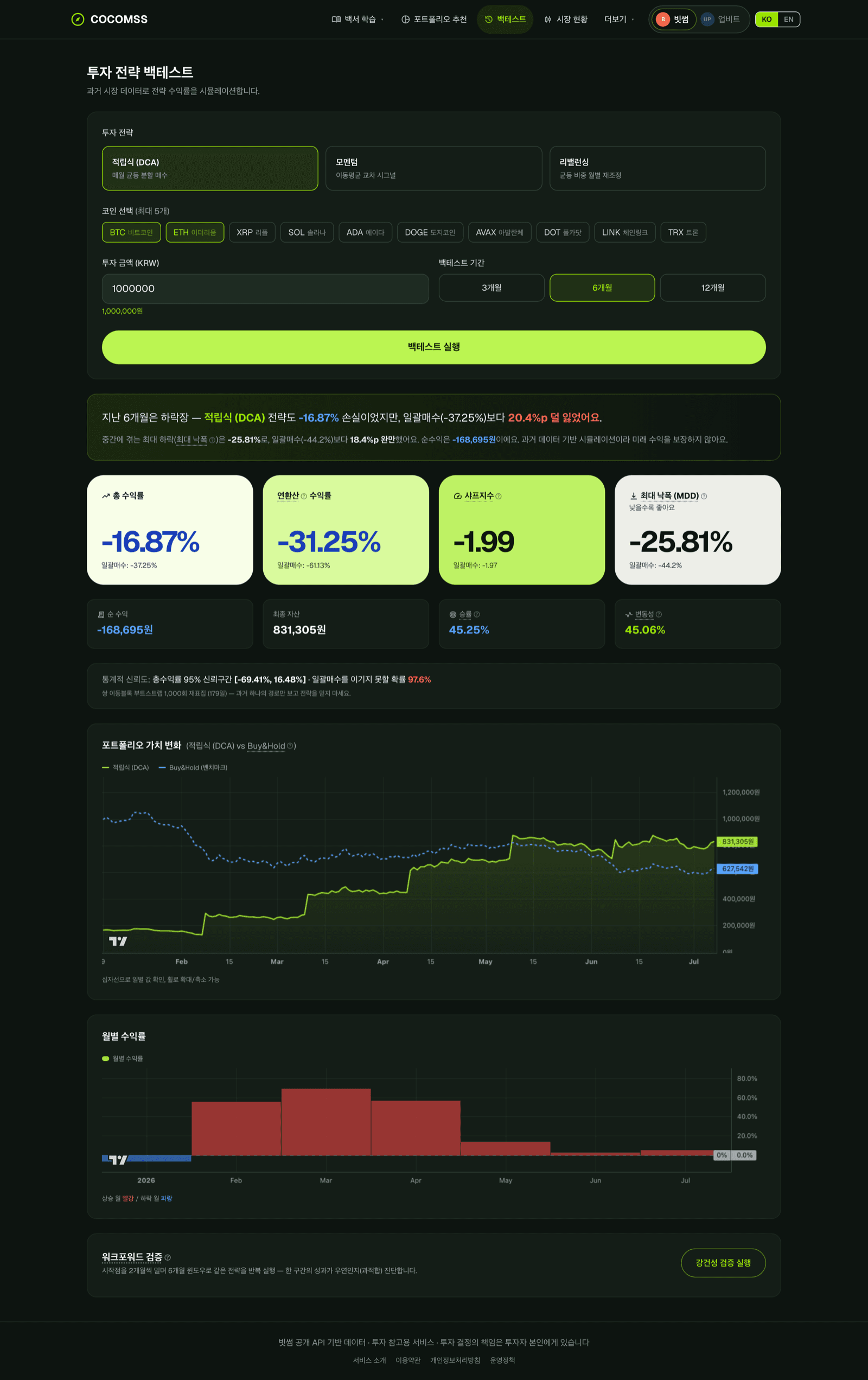
DCA, momentum, and rebalancing strategies include fees, slippage, signal lag, and walk-forward. A 1,000-run bootstrap reports the "chance of no edge over buy-and-hold" with a 95% CI. The conclusion is stated first, then shown as a strategy-vs-Buy&Hold curve.
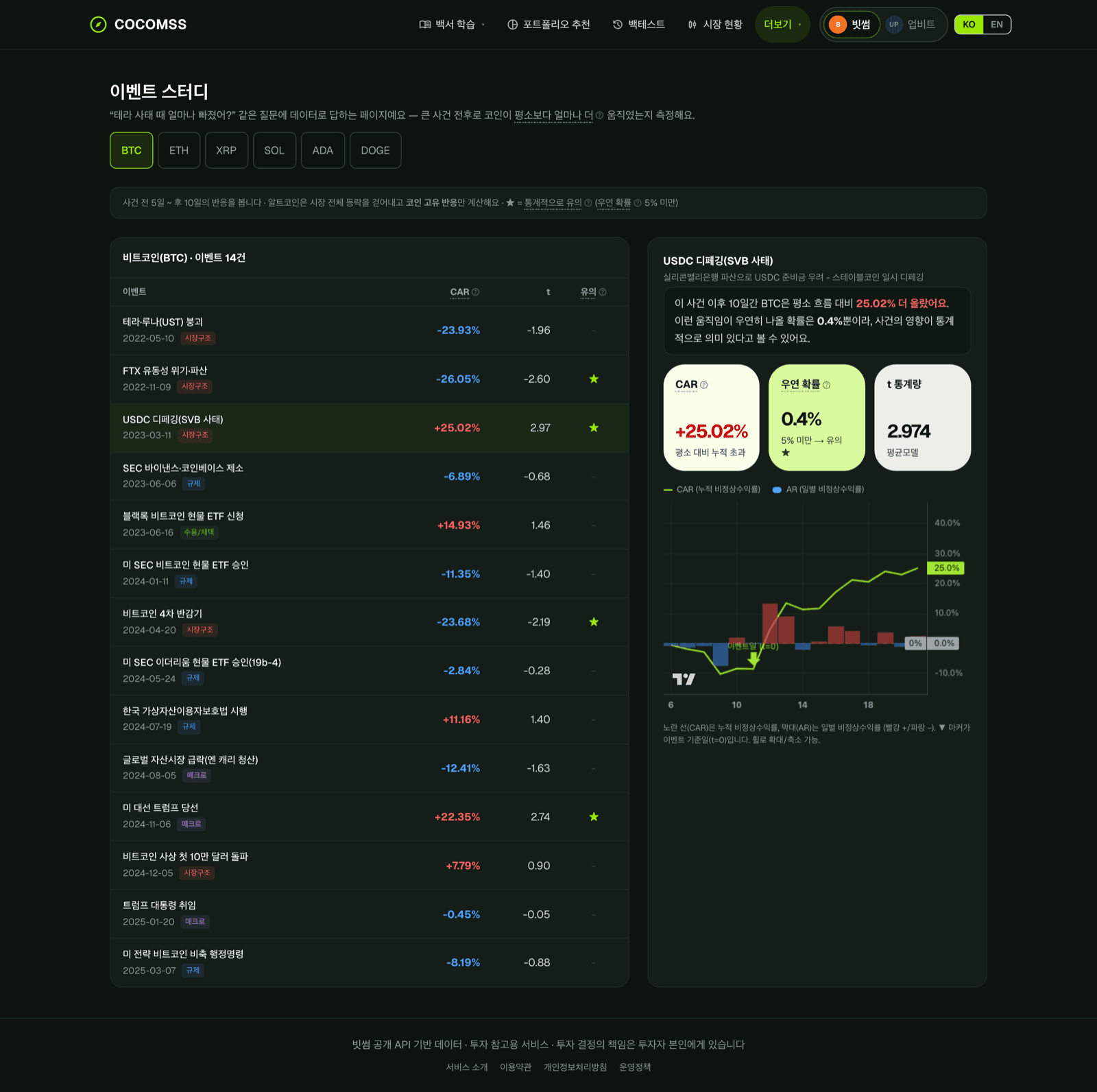
Screens — Verify: Event Study (AR/CAR + t-test)
Answers "how far did it fall during the Terra collapse?" with numbers. A market model strips market-wide movement and keeps only the event's abnormal return (CAR). A t-test then separates it from luck. This is the equity-research methodology ported to crypto. Validated on BTC real data, it reproduces economically sensible figures. Terra/Luna collapse −24.7% · FTX bankruptcy −23.2% · Trump election +23.7% · Korea's crypto-user-protection act +16.7%, all significant. ETF approval was −8.3%, matching the "sell-the-news" view, and the 4th halving −16.2%, matching the "priced-in" view. Both were insignificant.
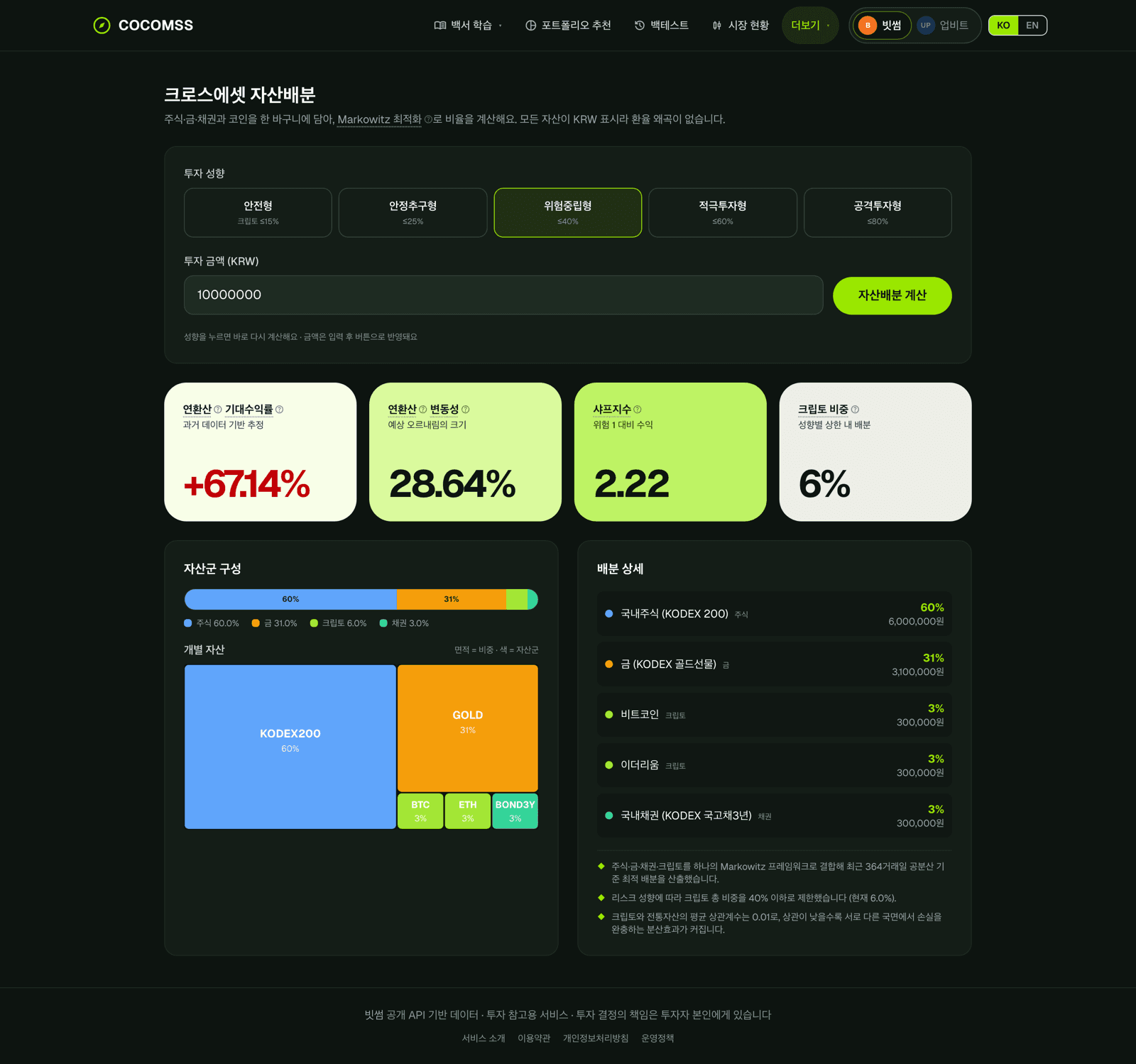
Screens — Verify: Cross-Asset Allocation
Combines stocks, gold, bonds, and crypto in one Markowitz optimization. All assets are priced in KRW to remove FX distortion. A risk-based cap limits crypto. The diversification from low correlations is shown as a treemap.
Screens — Exchange Core: Matching Engine Demo
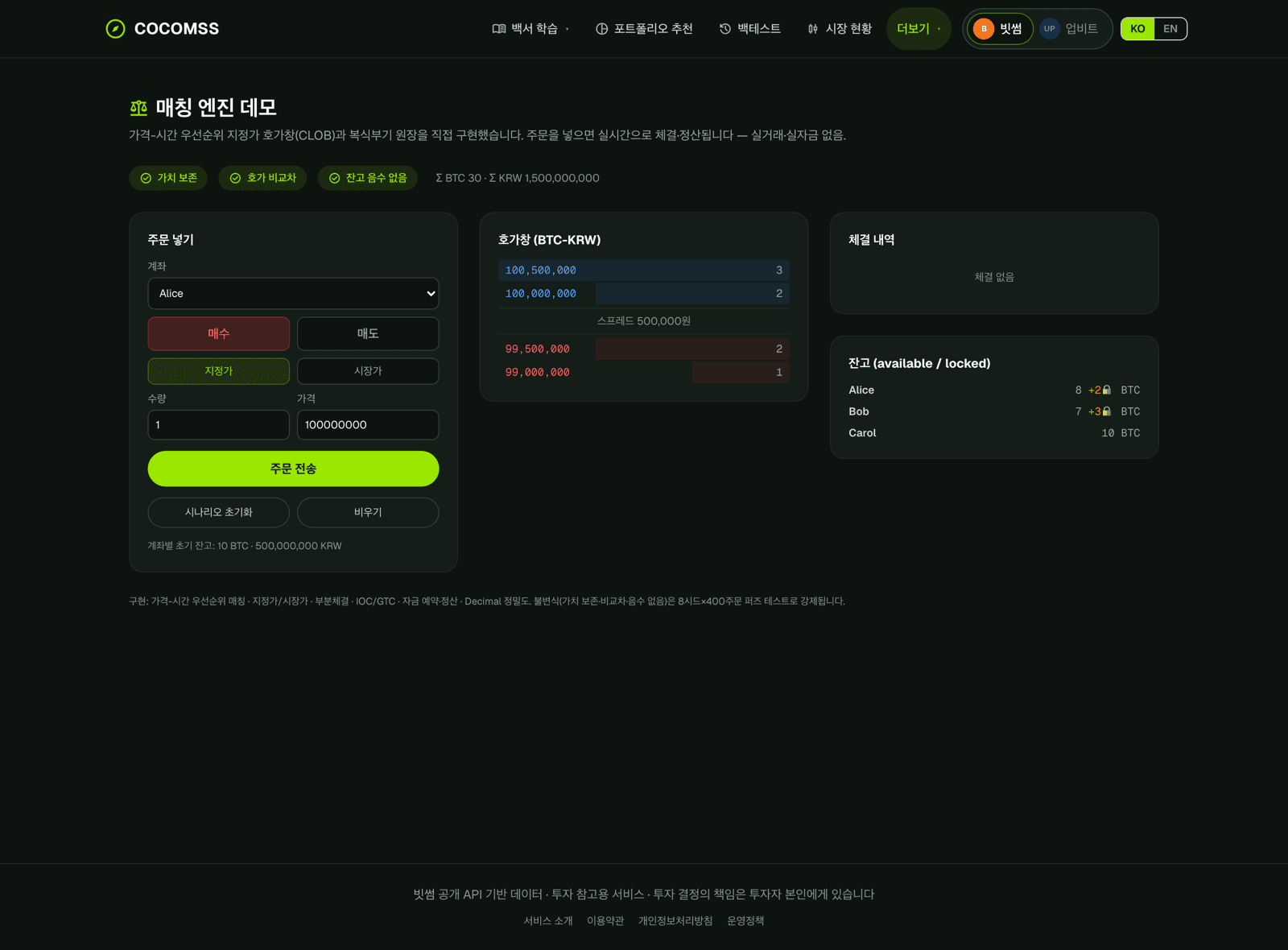
A service that only consumed prices gained exchange-backend correctness built directly. It has a price-time-priority order book (CLOB) and a double-entry ledger. Orders match and settle in real time. Value conservation, no crossed book, and no negative balances are enforced as invariants (no real trading or funds).