Overview
Goorm & Fintech Support Center · Mar–Nov 2026 · Full-stack build
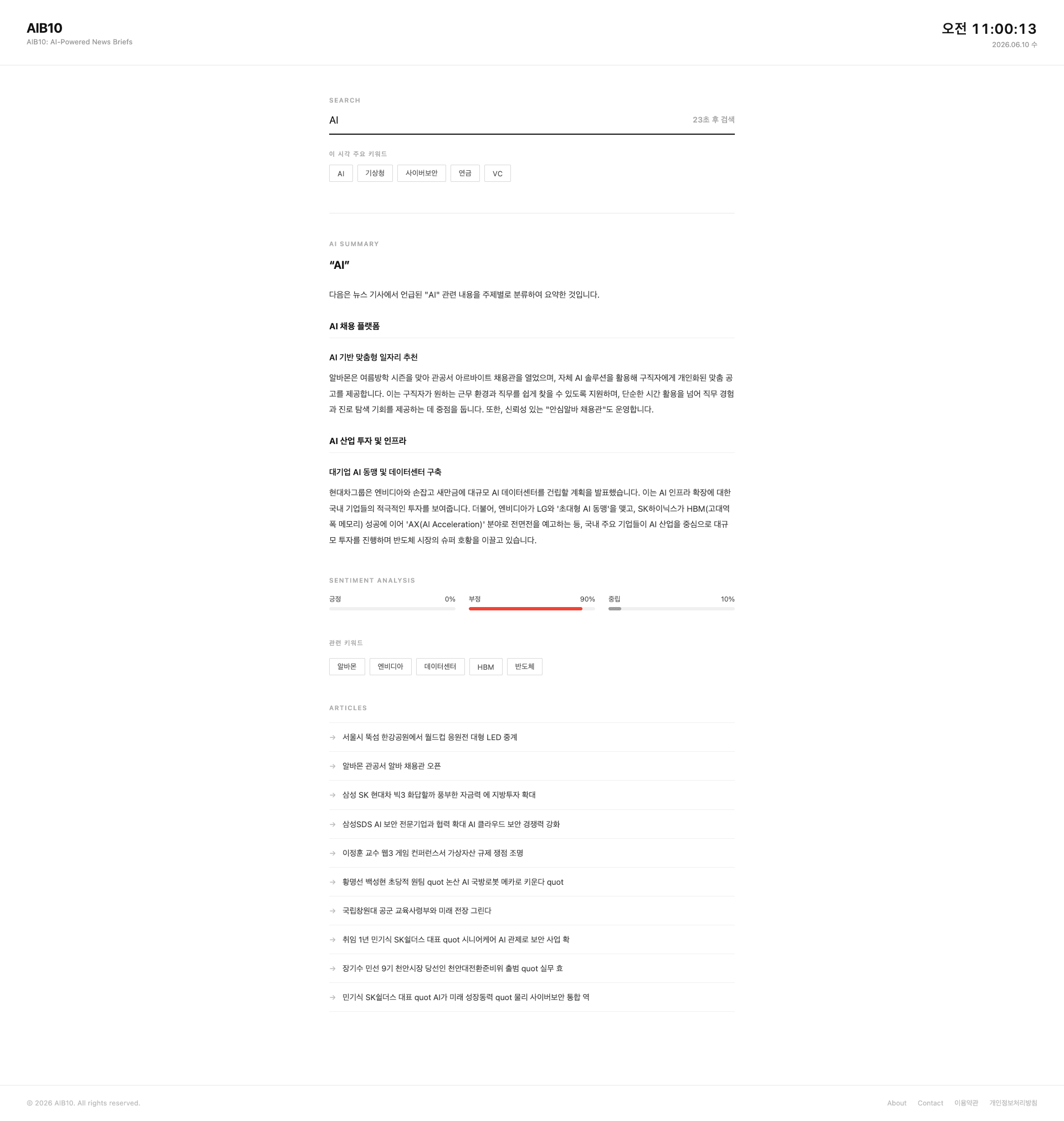
Built 'AIB10', a full-stack news-insight service that collects, summarizes, and sentiment-analyzes Naver news, delivered through both a web app and a Chrome extension.
- Naver news collection → topic-wise summarization with Gemini
- Sentiment analysis runs Gemini on article titles as the primary path. On API error or quota limits it falls back automatically to a self-trained deep-learning model (TF-IDF + Keras)
- News insight down to related-keyword suggestions
- The web app and the Chrome extension (MV3, popup/side-panel toggle) share a single FastAPI backend
- Built collection, summarization, sentiment, deployment (Docker·Nginx·EC2), concurrency, and cost control end to end
- Skill: service planning/full-stack build, hybrid sentiment (fallback design), prompt engineering, infra/concurrency/cost design
- Stack: FastAPI, Gemini API, TensorFlow·Keras, Naver News API, Chrome Extension (MV3), Docker·Nginx·EC2
Problem
Amid the daily flood of news, users struggle to grasp the key trends and market mood quickly. Plain summaries fail to surface sentiment and context such as positive or negative tone. The context in which people read news, on a web page or mid-browsing, also varies.
Key point
Gemini is the primary and a self-trained model is the fallback, so the service gets both accuracy and continuity. It was designed on the assumption that external dependencies fail and hit limits.
Solution
- Gather articles via the Naver News API and summarize them by topic with Gemini
- For sentiment, Gemini classifies article titles as positive, negative, or neutral. Article bodies were collected at first, and in September 2026 this was changed to titles only. On Gemini error or daily-quota limits it falls back automatically to the self-trained model (TF-IDF + Keras) so the service keeps running. The fallback model was trained on NSMC and about seven thousand real news titles labeled with Gemini. The path used is shown in the UI
- On one FastAPI backend, ship both a web app and a Chrome extension (dynamic popup/side-panel switching) so users pick what fits their context
- Deploy on Docker·Nginx·EC2 with extension-origin CORS, per-IP rate limiting, concurrent-request parallelization, and API-call and cost control
- 1Collect newsArticles via the Naver News API
- 2SummarizeTopic-wise summaries with Gemini
- 3Analyze sentimentGemini judges pos/neg/neutral
- 4DeliverWeb and Chrome extension, one backend
| Primary | Fallback | |
|---|---|---|
| Model | Gemini | Self-trained deep-learning model (TF-IDF + Keras) |
| Goal | Accuracy first | Continuity |
| When used | Default path | Gemini error or daily-quota limit |
Result
- Completed a full-stack pipeline from collection through summarization, sentiment, and deployment
- Combined Gemini as the primary with a self-trained model as the fallback, securing both accuracy and continuity against outages and limits
- Delivered the same service across the web and a Chrome extension (extension published on the Chrome Web Store)
- Built an operable service that accounts for infrastructure, concurrency, and cost
- After accounts and Watch went public, 80 days passed with no outside sign-ups, and the service was shut down on November 26, 2026
Retrospective
Owned the whole process from service planning to model training, deployment, and cost defense.
Gemini, as the primary, is responsible for accuracy, and the self-trained fallback model for continuity. Reliability was designed with the outages and limits of external dependencies factored in.
Served both the web and a Chrome extension from a single backend and thought through delivery tailored to the user's context.
Done again, traffic would come before features. A web-store listing, a landing page, and 19 days of short-form promotion produced no sign-ups. Implementation would start only after meeting target customers and confirming demand. The record up to the shutdown is in Ending AIB10, and the 80 Days Without a Single Sign-up.
Links
- The service was shut down on November 26, 2026
- The shutdown record ›
- Features and screens ›
- Logic design ›
- Infrastructure ›