Overview
Team project (5 people, team "hope") · Aug 2026 · Admin full-stack · Data pipeline
Pop Talk was built in two weeks as the team project of the NIPA·Naver Cloud Sovereign AI PBL program. Describe your situation in plain language and it recommends a film. The service verifies the grounds for that recommendation before showing it. It won the excellence award in the program evaluation.
- Five of us split web, WAS, chatbot, batch, and admin. I held the admin console's front and back ends and also handled review data collection, loading, and transformation
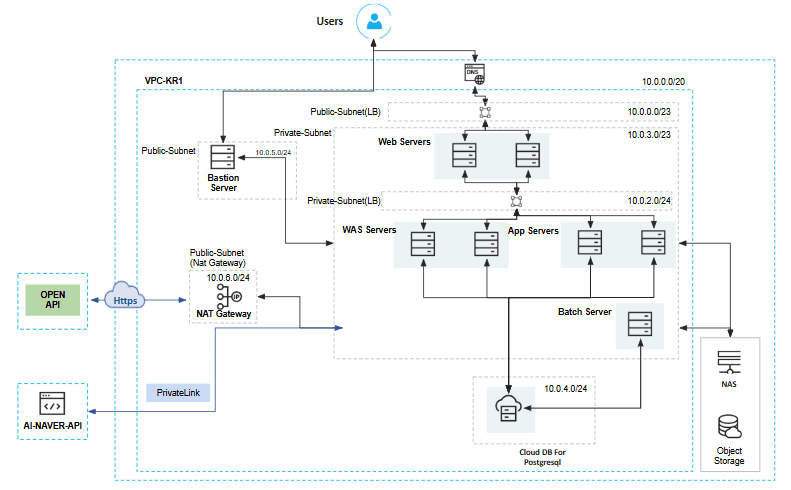
- The infrastructure ran on eight servers inside one Naver Cloud VPC: two web, two WAS, two chatbot backends, one batch, and one bastion as the only door into the private range
- Recommendation runs on vector search built with CLOVA Embedding; the chatbot backend composes its agent with CLOVA Studio and LangGraph
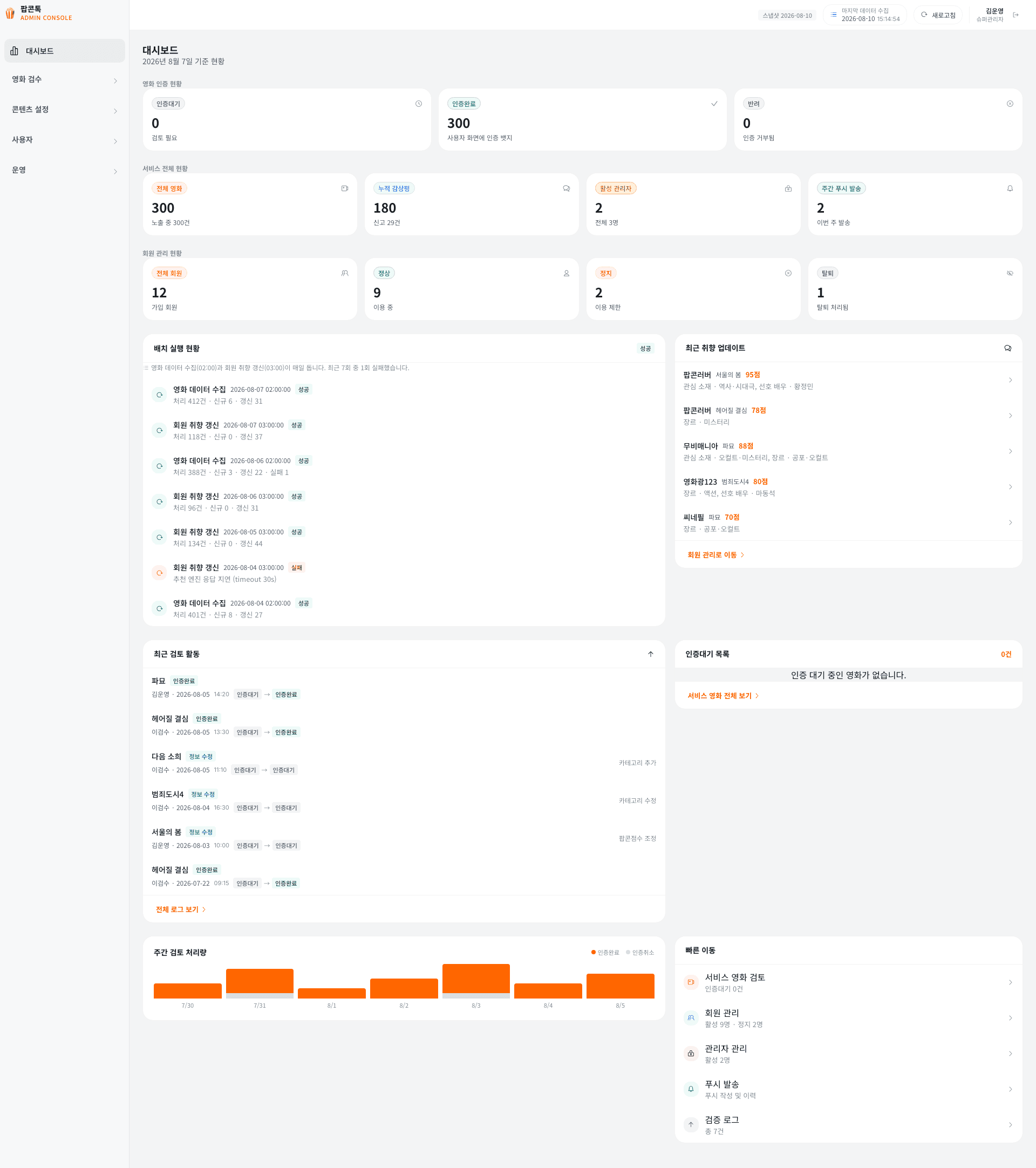
- The admin console was built spec first, with 35 OpenAPI 3.1 endpoints written before any screen. CI blocks breaking changes
- The review data pipeline collected 117,514 audience reviews and loaded them. A portion was rewritten with HyperCLOVA X into virtual-member reviews, reaching 124,939 service reviews
- Skill: back-office planning and full-stack build, API contract design (OpenAPI) with CI enforcement, web scraping pipeline design, LLM prompt tuning, cloud infrastructure audit
- Stack: Next.js 16 · React 19 · TypeScript · Seed Design, FastAPI, PostgreSQL, Selenium, HyperCLOVA X (HCX-007) · CLOVA Embedding, Naver Cloud Platform (VPC · ALB · Cloud DB for PostgreSQL · Object Storage · NAT Gateway)
Problem
Generative AI recommends movies well enough. The problem is that there are no grounds to trust the recommendation. A user has no way to confirm that the film the model named actually exists. Whether it really fits "under two hours" is unknown too. The same goes for whether the review quoted as a reason was written by a real person. The conventional flow runs straight from question to recommendation and stops there.
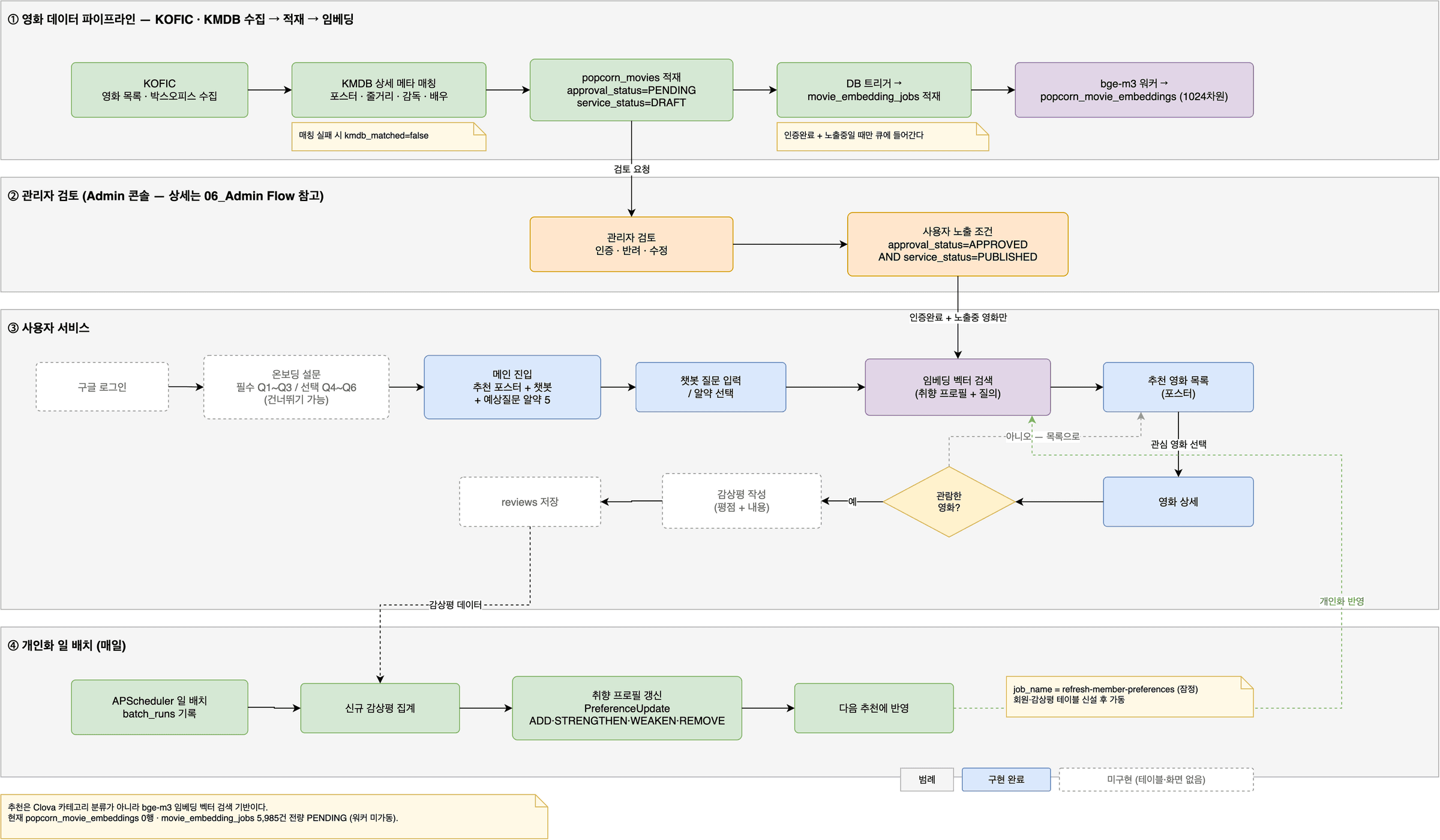
So the team decided to insert two steps. After taste analysis and generation comes verification, and only what passes goes out as a card with its reasons attached.
That decision is exactly why my two areas existed. First, verification results need a human to confirm them, which requires a back office. Without a screen where an administrator reviews what the AI certified and decides on exposure, "we verified it" proves nothing. Second, verification only holds if there are reviews to cite as evidence. The service database held exactly seven at the start.
Key point
Verification sits after taste analysis and generation. Only what passes goes out as a card with its reasons attached.
Solution
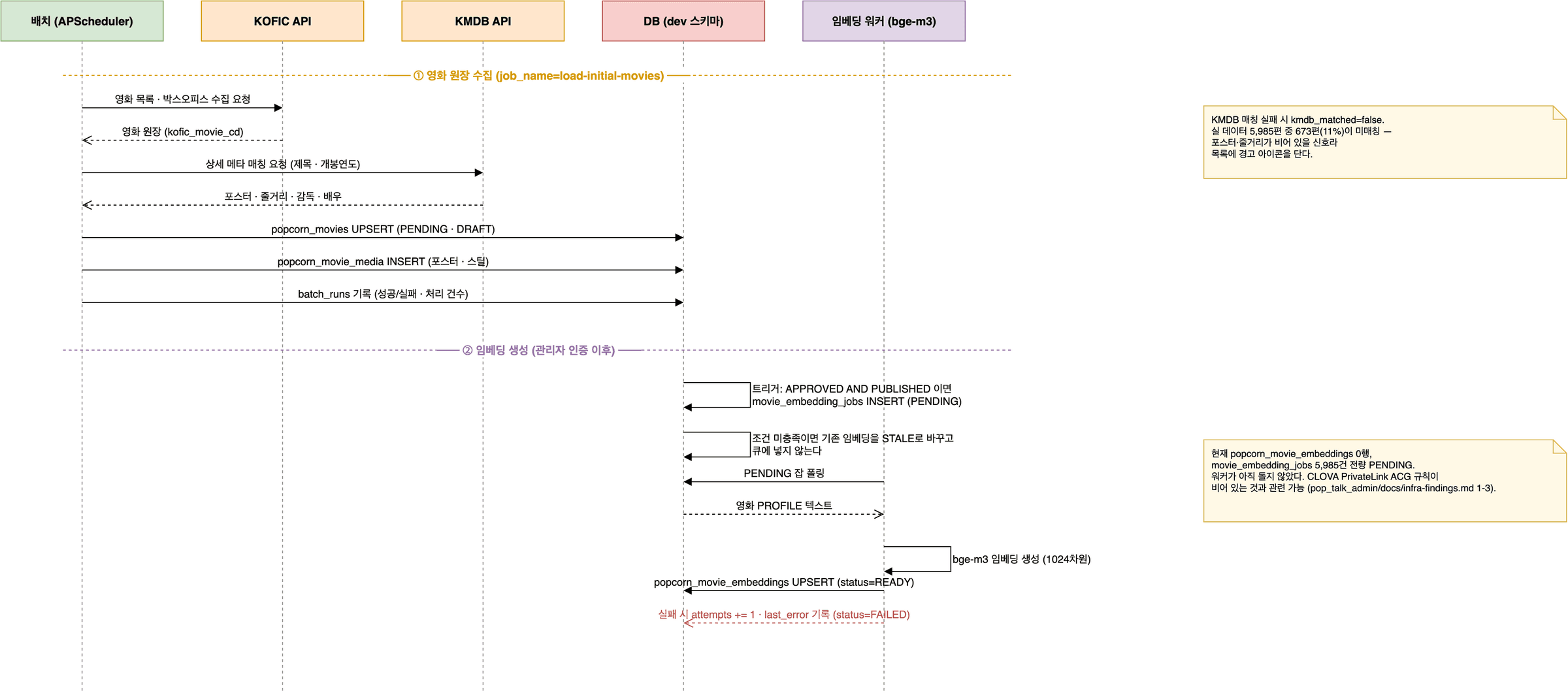
The team split the service into four bands. The pipeline collects and loads movie data. Admin review is where a person inspects it. The user service surfaces only what passed. The personalization batch feeds reviews back into taste profiles. My two areas were the whole second band and manufacturing the reviews the third band would cite.
Admin console — spec first, enforced by CI
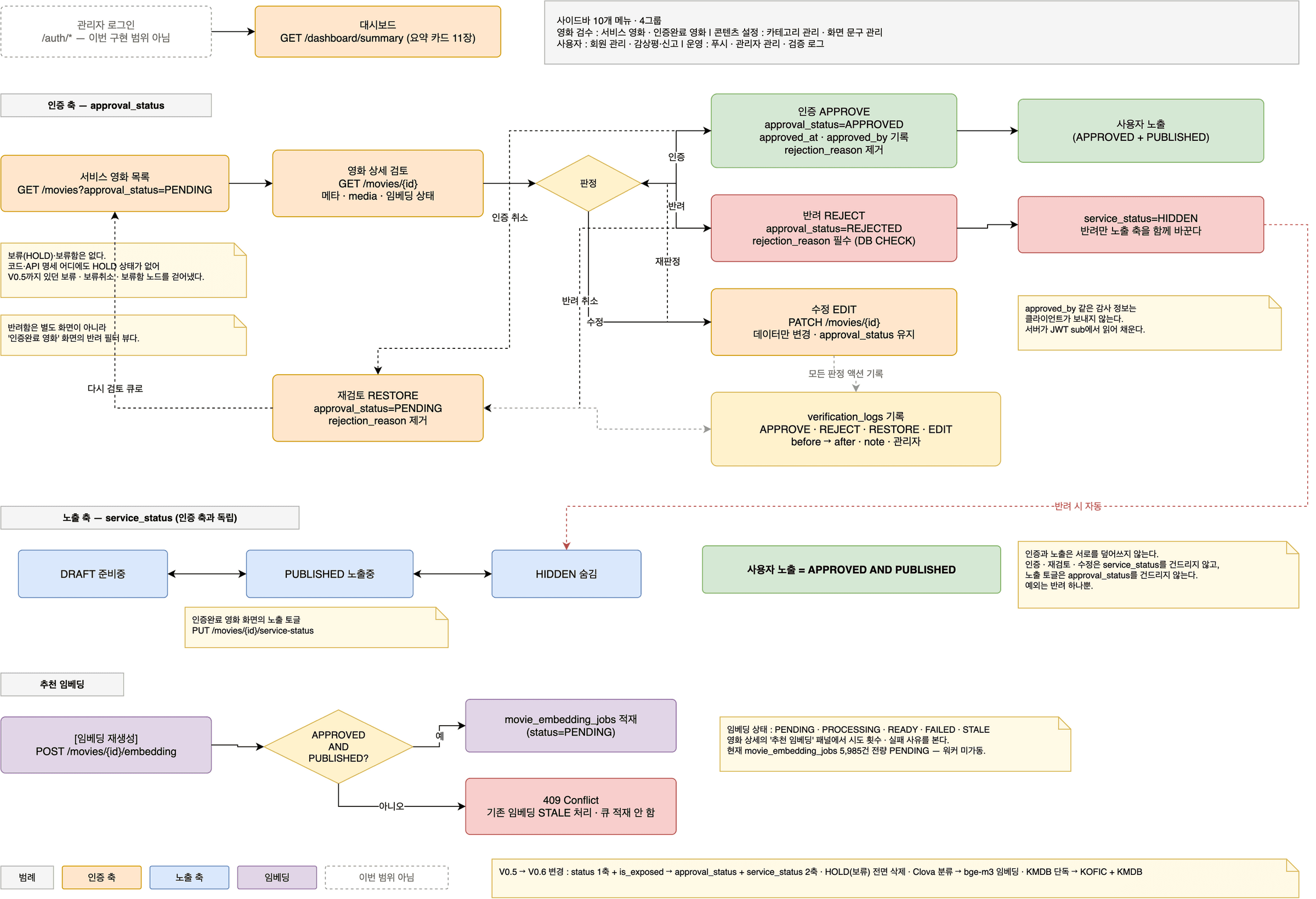
On a two-week project with five people working against the same API, verbal agreement is guaranteed to drift. So the spec came before the screens. Thirty-five endpoints across 28 paths were defined in OpenAPI 3.1. The spec bought three things.
First, screens got built with no backend behind them. A mock server ran from the spec alone, right down to returning 422 when a string is passed as the page parameter. Second, the same spec was built into two static documents, one for reading and one for calling. Skimming and calling are different needs. Third, on any PR touching the spec, CI catches breaking changes.
The third meant building the diff tool myself. The standard linter has no diff command. The npm ecosystem's diff tool reads only up to OpenAPI 3.0 while this spec is 3.1. The tool that reads 3.1 properly is a Go binary, heavy to drag into an npm project. It judges fourteen kinds of change as breaking: deleted endpoints, parameters, and response fields, optional fields made required, and type changes. Safe additions such as a new endpoint or an optional parameter pass. Adding a response enum value is strictly breaking, but with states still multiplying it only warns.
On the UI side, the highest-value decision was unifying the status badges into one. Every screen had grown its own status tag, so the same "suspended" looked different depending on where you saw it. The design system's tone definitions mapped onto this domain exactly, reducing four kinds to one. Table typography was cut to two steps only, body and secondary. Before that, three sizes mixed inside a single cell produced nine combinations. The ten menu items were grouped into four collapsible groups by what they do. Laid out flat, a screen opened daily and one opened quarterly carry the same weight.
Data ran on a three-tier fallback. The live database sits inside a private subnet, so screens wouldn't render outside the team. Falling back from live DB to a 300-title snapshot to mock data kept it openable anywhere while keeping screens drawn from real data.
The most consequential modeling decision was splitting state into two axes. The original plan had one status axis plus an exposure flag. That structure could not express "certified but not visible yet" or "certification revoked but keep it on screen." The certification axis was separated from the exposure axis, and user visibility was defined as the single intersection of the two. The ambiguous "on hold" state then disappeared entirely.
Review pipeline — manufacturing the evidence that didn't exist
Verification is impossible with seven reviews. We filled the gap from Naver audience reviews.
requests couldn't do it. A 200 response with a megabyte of HTML carried zero review cards. The reviews aren't in the server HTML; the browser draws them with JS. Past the first twenty, they load only as the container scrolls. So Selenium drove a real browser to collect them.
Collecting revealed a ceiling of 310 items per sort order. No amount of extra scrolling gets past 310 in one sort. Switching the sort tab between most-liked and most-recent rebuilds the list with low overlap. Merging both and de-duplicating yields up to roughly 570 per film. To avoid blocks, request intervals varied every time. Scrolls were 1.4 to 2.6 seconds apart and films 4 to 8 seconds apart. An automatic stop kicked in after five consecutive films returned nothing. Fourteen hours of running produced zero blocks.
Loading was designed to be idempotent. A UNIQUE index on a content-based hash means reloading never grows the table. A first pass of 1,717 reviews across three demo films validated the path. The second pass inserted 58,445 new rows in ten seconds.
Copying collected reviews straight into member reviews would show the same sentence twice in one list. They were rewritten by HyperCLOVA X with the original voice preserved and assigned to 300 virtual members. That took three prompt revisions. The first inflated originals to 5.5× their length and slipped titles into sentences. It also softened harsh reviews until the meaning inverted. The second fixed length, titles, and distortion but still turned casual speech polite in three of ten. The third detected the original's sentence endings in code and injected them into the instruction, and voice preservation hit ten of ten.
One more thing came out of this. Metadata leakage could not be stopped by prompting. However firmly the instruction forbade putting titles and ratings into the sentence, it leaked probabilistically. It ended up filtered in code, discarding after three failed attempts. The first demo batch hit rate limits from concurrent calls and dropped to sequential.
Author IDs are hashed at write time so no original reaches disk. Since the source text is real users' writing, the whole dataset is marked internal demo only.
A byproduct — the infrastructure audit
Designing the admin backend required knowing how the servers were actually exposed. Current state was read through the NCP API, reads only, and compared against the architecture document. That turned up eight servers, eight ACGs, and 25 rules. Between documentation drift and things needing action, fifteen findings were written up.
The most urgent was port 22 on the bastion being open to the entire internet. A rule allowing one specific IP sat above a blanket allow rule that rendered it meaningless. The bastion is the only door into the whole private range, so the blast radius was large. Beyond that, a database password was written in plaintext in the team document. No public entrance to the backend was defined, which meant deciding the deployment path first. The single-instance database was a point of failure. These were bundled into nine prioritized steps. Nothing was changed, only read. Those calls belonged to their owners.
Result
- Team hope's Pop Talk took the excellence award in the program evaluation
- The admin console shipped in 39 commits with 10 screens, a 35-endpoint spec, and two static API documents, deployed within two and a half days
- CI now catches 14 kinds of breaking change, so the API contract no longer depends on anyone's memory. Screens can be built ahead of the backend
- Reviews grew from seven to 124,939. 117,514 reviews across 1,197 films were collected in 14 hours with zero blocks and loaded as 118,301 rows, plus 6,638 reviews from 300 virtual members
- Three prompt rounds reached 10/10 voice preservation. Detecting original sentence endings in code and injecting them eliminated the register distortion
- 15 infrastructure risks were documented, including the wide-open bastion SSH, and delivered to the team as nine prioritized steps
Retrospective
Two weeks is too short to build every feature and long enough to decide what not to build. Holding onto verification as the single value sorted everything else. No reviews means no verification, so data collection came first. Verification results need human confirmation, so an admin console was needed. Vector search was chosen, so the batch server runs embeddings. Deciding the value before writing the feature list was the best call of a short project.
A contract is kept by a failing check. Writing a good spec blocks nothing on its own. Only when a break fails the PR and a comment names what broke does the agreement live outside anyone's memory. The tooling didn't exist and had to be built. Once it did, five people working against one API never drifted.
Telling an LLM not to do something is different from making it unable to. Metadata leakage seeped through no matter how tightly the prompt was written. It stopped only once a code filter went in. Voice preservation, conversely, was solved by prompting. Even that worked not by asking it to "preserve the voice" but only after the original's sentence endings were detected in code and handed to the instruction. Prompt engineering turned out to be the work of dividing what the model judges from what the code decides in advance.
The regret is the stretch where documents aged faster than code. The initial planning model used one status axis plus an exposure flag. The implementation went to two axes, approval and service. The diagrams had to be redrawn after the fact. CI guarded the spec, and nothing guarded the diagrams. Next time the drawings should be generated artifacts too, pulled from the source.