What we built
Pop Talk is a personalized AI agent that verifies why it picked a film and shows that reasoning. Five of us, team "hope," built it between August 7 and 13. It took the excellence award in the program evaluation.
The problem statement was simple. Generative AI recommends movies well. What it doesn't give you is grounds to trust the recommendation. So we inserted two steps.
Typical    question → recommendation → done
Pop Talk   question → taste analysis → generate → verify → give reasons
Four values were fixed: personalization, explainability, verification, trust. Verification was the constraint that pulled in everything from week one. The service confirms the film exists in the database. It also confirms the film meets the stated conditions (runtime, rating) and that the reviews cited as grounds are real. Only then does a card go out.
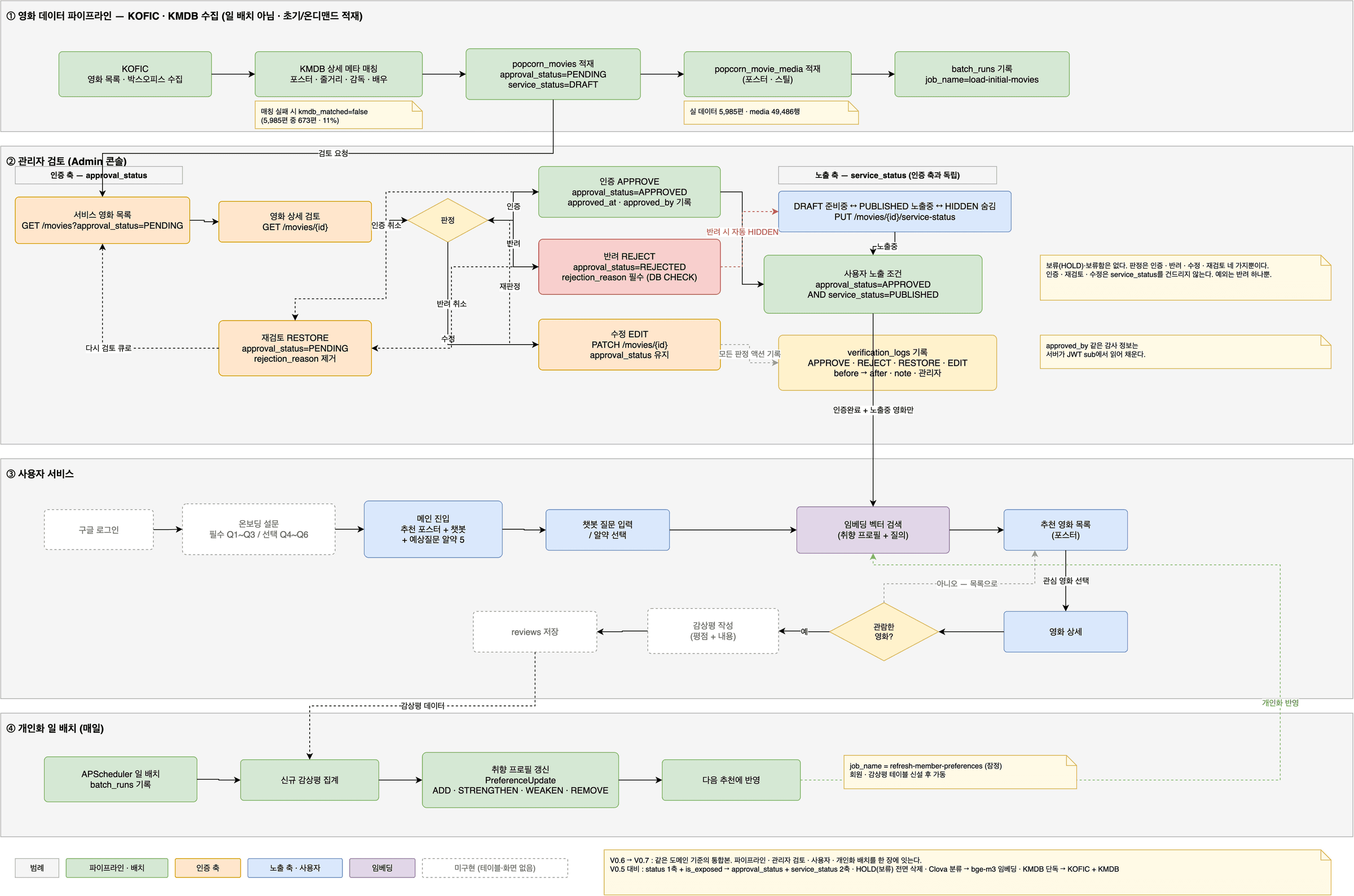
Drawn on one page, that becomes four bands. Collection feeds the raw material in. Review filters it. The user screens use only what survived. A batch turns readers' reviews back into taste. The point of the picture is that material cannot reach a screen without passing administrator review.
The shape we put on NCP
Week one's lab order became the build order.
popcorn-vpc (10.0.0.0/20)
├─ lb-public      Public ALB     → web × 2
├─ lb-private     Private ALB    → was × 2 · backend × 2
├─ app-private    web 2 · was 2 · backend 2 · batch 1   (Rocky 9.6)
├─ db-private     Cloud DB for PostgreSQL (standalone)
├─ bastion-public the only door in from outside
└─ nat-public     NAT Gateway — outbound for the private subnets
- web runs Next.js and was runs FastAPI. backend is a CLOVA Studio agent on LangGraph and batch is APScheduler
- The batch server does two things. It syncs movies daily from KOFIC and KMDB and embeds movies and reviews via CLOVA Embedding (recommendation runs as vector search)
- ACGs split per server group, with port 22 open only from the bastion ACG. Private subnets reach outward through NAT only
- Storage split between NAS (initial setup) and Object Storage (posters and other static content)
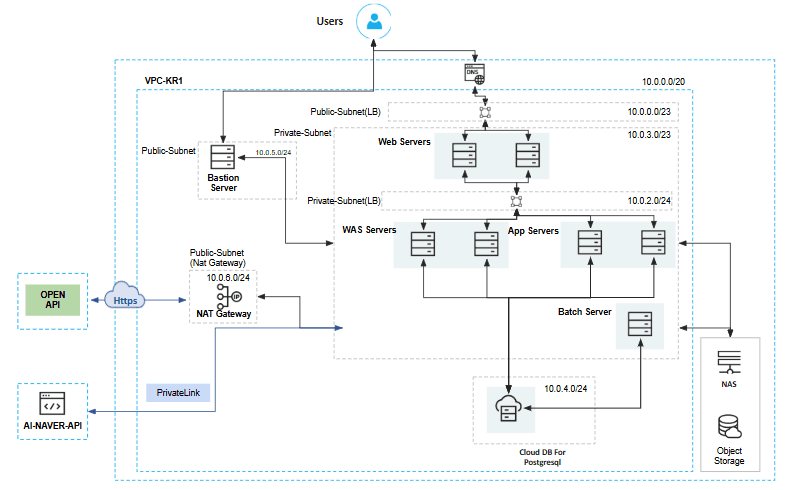
In week one I wrote that drawing the network last makes everything above it a workaround. The value of that sentence showed in week two, when no server had to be rebuilt.
First deck — the admin console
A back office where a human reviews and certifies what the AI recommended. I held both the front end and the back end, from the first commit in the early hours of August 8 through 39 commits.
The spec came first. Thirty-five endpoints were defined in OpenAPI 3.1. That bought three things.
- Screens before a backend. A prism mock server ran from the spec alone. Even
?page=abcreturning422works from the spec - Two documents. The same spec was built into static Redoc (for reading) and Swagger UI (for calling) and deployed
- CI blocks breaking changes. Checks run on any PR that touches the spec
The third meant writing the diff tool myself. @redocly/cli has no diff command. npm's openapi-diff only reads up to OpenAPI 3.0 while this spec is 3.1. oasdiff, which handles 3.1 properly, is a Go binary and heavy to drag into an npm project. It catches fourteen kinds of breaking change such as deleted endpoints, parameters, or response fields, newly required fields, and type changes. Safe additions such as a new endpoint or an optional parameter pass. Adding a response enum value is strictly breaking, but with states still multiplying it only warns.
On the UI side the highest-value decision was unifying the status badges into one. Every screen had grown its own .statusTag / .actionTag / .changeTag / .reportTag, so the same "suspended" looked different on different screens. The design system's tone definitions (approved/complete vs. rejected/sanctioned) mapped onto this domain exactly, so one badge replaced four.
Data ran on a three-tier fallback. The order is live DB → a 300-title snapshot → mock data. The live DB lives inside the VPC, so screens wouldn't render outside the team. The fallback fixed that without giving up screens rendered from real data.
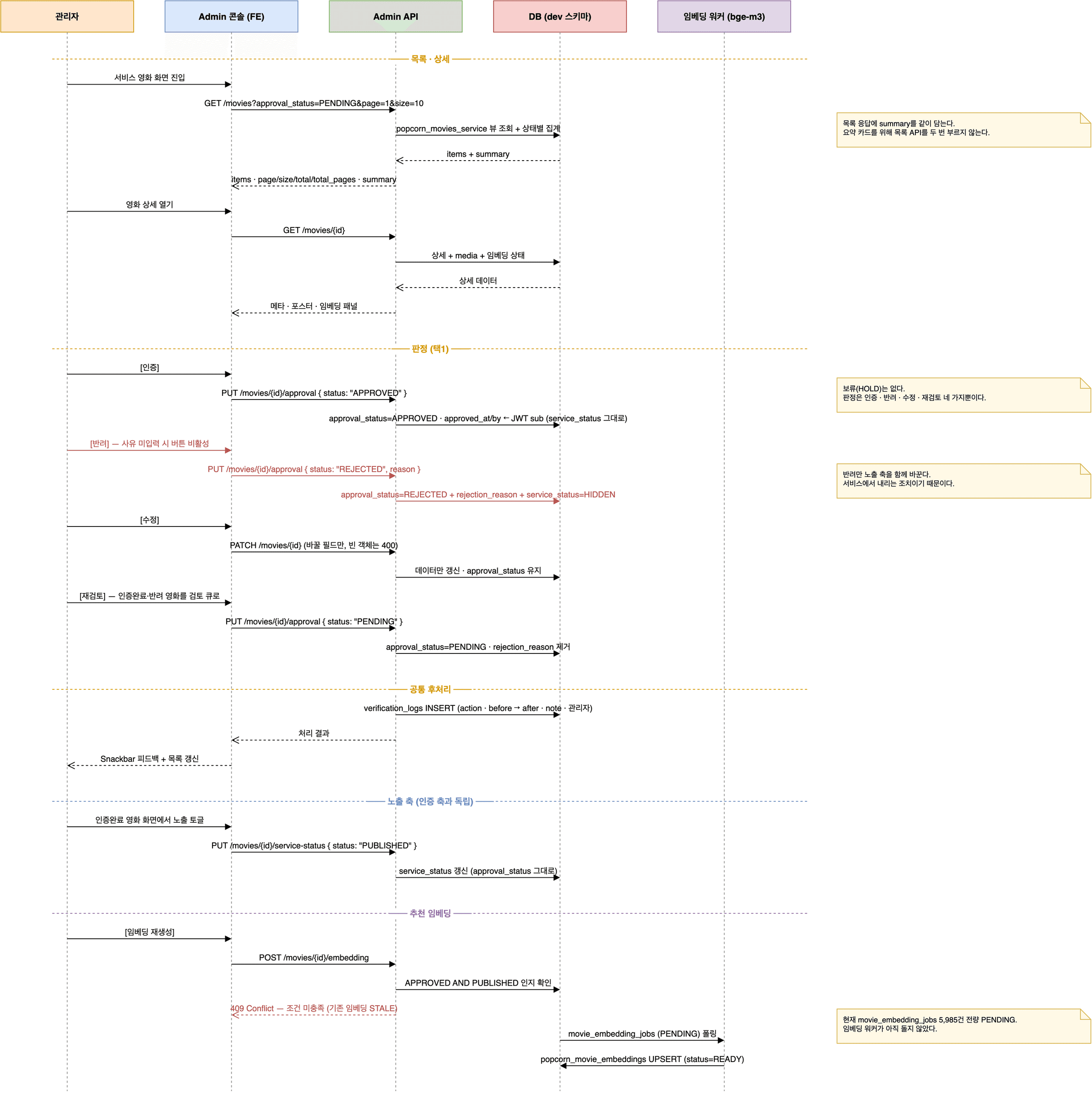
Writing the spec first also meant the order of traffic between screen, API, and database could be drawn in advance. Whoever built the backend only had to follow the arrows.
Second deck — review data
Verification needs reviews to cite as grounds. The service had seven of them. We filled that from Naver audience reviews.
requests couldn't do it. A 200 with a megabyte of HTML carried zero review cards. They're drawn by JS in the browser, and past the first twenty, more load only as you scroll the container. So I switched to Selenium.
Along the way I found a 310-item ceiling per sort order. No amount of extra scrolling passes 310. Switching the sort tab (most-liked ↔ most-recent) rebuilds the list with low overlap. Merging both sorts and de-duplicating yields up to roughly 570 per film.
Collected   1,197 films · 117,514 audience reviews   (14 hours, zero blocks)
Loaded      118,301 rows in dev.reviews              (SHA-256 UNIQUE on content — reloading never grows it)
Converted   300 virtual members · 6,638 member reviews
Total       124,939 service reviews
Copying collected reviews straight into member reviews would show the same sentence twice in one list. So they were rewritten by HyperCLOVA X (HCX-007) with the original voice preserved. That took three prompt revisions.
| Round | Symptom |
|---|---|
| v1 | Inflated length 5.5× · title inserted into the text · harsh reviews softened · meaning inverted |
| v2 | Length, titles, and distortion fixed; casual speech turned polite in 3 of 10 |
| v3 | Original sentence endings detected in code and injected into the instruction → voice preserved 10/10 |
One more thing came out of this. Metadata leakage (slipping the title or rating into the sentence) could not be stopped by prompting. However firmly forbidden, it leaks probabilistically. It ended up filtered in code, discarding after three failed attempts. The first demo batch hit 429 rate limits, resolved by dropping to sequential calls.
Author IDs are SHA-256 hashed at write time so no original ID reaches disk. Since the source text is real users' writing, the dataset is marked internal demo only.
What this left
Key point
Two weeks is too short to build every feature and long enough to decide what not to build. Holding onto verification as the single value sorted the rest. Without reviews there is no verification, so data collection came first. Verification results need human confirmation, so an admin console was needed. Vector search was needed, so the batch server runs embeddings.
Technically, the thing most likely to outlast the project is writing the spec first and letting CI enforce it. With five people and two weeks, verbal agreement will drift. When a broken spec fails the PR and a comment says what broke, that agreement lives outside anyone's memory.
The regret is the stretch where documents aged faster than code. The V0.5 planning model (one status axis plus an exposure flag) diverged from what got implemented (two axes: approval and service). It had to be redrawn as V0.6 and V0.7 after the fact. CI guarded the spec, but nothing guarded the diagrams.