Overview
Coconut Silo (industry collaboration) · Apr–Jun 2026 · Data-driven PM / Planner (team of 2)
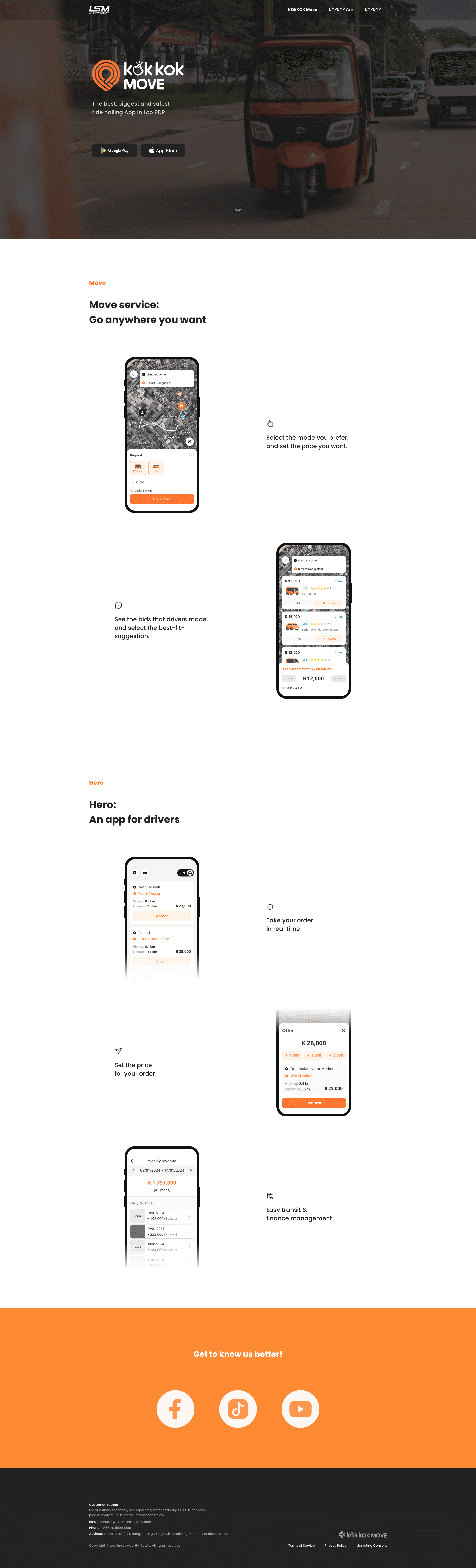
In partnership with mobility company Coconut Silo, planned the Laos EV charging service Kokkok EV. It was a two-person team.
- Collected 38K+ multichannel VOC across Laos/Vietnam (+Thailand benchmark) into 9 PostgreSQL tables across 4 languages.
- Ran multilingual sentiment analysis (XLM-RoBERTa, 100 languages without translation) and analyzed along two axes, the app layer and the hardware layer.
- Derived a data-grounded PRD (11 features: 6 app + 5 HW, prioritized P0–P2), market research, and a pricing policy, visualized in 20 charts.
- Methodology combined CRISP-DM and SDLC. Data work followed CRISP-DM, and deliverables mapped to SDLC's plan → analysis → design (development out of scope).
- Stack: PostgreSQL·Supabase, XLM-RoBERTa, Python·pandas, Matplotlib·WordCloud, Figma, draw.io·Tableau
Problem
Local VOC and market data on the Laos/Vietnam EV market were scattered, leaving no basis for planning. Objective data had to come first.
The assumption that app-error complaints came from charger communication (OCPP) rather than app bugs was in common use without anyone separating the two. It had to be tested against data.
Key point
Working in the order of VOC collection, hypothesis testing, and PRD writing, I defined features by evidence instead of guesswork.
Process — Five stages from data to product
The workflow was structured as five stages: plan, collect, analyze, visualize, and plan the product. Each stage's goals, deliverables, and review points were documented.
- 1PlanDRD question-to-data mapping, WBS
- 2Collect38K+ VOC from 5 channels
- 3AnalyzeXLM-RoBERTa sentiment on 34,144
- 4Visualize20 static charts + Tableau
- 5Plan the product11-feature PRD + pricing policy
1. Plan — what, why, and with which data
- Refined the plan from analysis goals through data requirements (DRD: question-to-data mapping, sampling, quality criteria) to a WBS. This corresponds to CRISP-DM business understanding and SDLC planning.
- Split the work in two. I took DE/planning (infra, schema, scraping, sentiment model, feature specs) and my teammate took DA/planning (cleaning, Lao/Vietnamese translation QA, statistics, Tableau, scenarios).
- The plan was revised as the data validated it. The ERD grew from 6 to 9 tables, SNS collection was deferred over Meta's ToS, and full translation was dropped for direct XLM-RoBERTa processing, cutting 12h to 2h.
2. Collect — 38K+ multichannel VOC
- Loaded 5 channels into PostgreSQL (Supabase) across 9 tables and 4 languages.
- App-store reviews 28,890 (Green SM 26,603, etc.), super-apps 3,370 (Grab·Gojek·LOCA·KOKKOK Move)
- YouTube 21 videos / 527 comments / 2,625 caption segments, 42 blogs, news VOC 733 / HW 1,327, Laos official/reference stats
- Solved three problems while collecting. LOCA EV had only 7 reviews, so three leading Thai apps were added as a comparison set. Green SM and V-Green shared one app ID, so rows went in as
country=MULand the country was inferred from the detected language. Google Play pagination capped at about 2,000, so independent token pools across 5 language/country combos were used for exhaustive collection.
3. Analyze — two layers × hypothesis correction
- Multilingual preprocessing ran language detection, XLM-RoBERTa sentiment (100 languages without translation), and rule-based keyword classification in that order. The analysis corpus was 34,144 entries.
- The app layer was read on a rating × negativity positioning map. Negativity was 53.5% overall, PTT blueplus+ set the benchmark at 3.11⭐, and PEA VOLTA was worst at 67.9% negative.
- 92% of app_reviews were ride-hailing (Green SM), so VOC was reclassified into two layers: ride-hailing / charging / app-common. Unclassified "other" fell from 50.0% to 16.6%.
- Among 1,227 negative charging-app reviews, the top issues were app stability 27.6%, account/KYC 15.0%, and payment 11.0%. The "app error = OCPP" causation was unsupported by VOC and was reframed as an interoperability standard requirement.
- In the hardware layer, charger defects were 32% negative, a greater severity than the more-mentioned OCPP. Laos and Vietnam were in infrastructure buildout, and Thailand in quality and standardization.
- The market was read through Laos news Share of Voice. The order was VinFast·Xanh SM > LOCA > KOKKOK, summarized in 6 reports.
- App stability
- 27.6%
- Account/KYC
- 15.0%
- Payment
- 11.0%
4. Visualize — 20 charts + Tableau
- Turned the analysis into 20 static charts (app VOC, hardware, linkage, Laos market) ready for decisions.
- Representative charts were app/HW positioning maps, sentiment by app, two-layer complaint distribution, app↔HW linkage, and Laos SoV.
- Also built Tableau
kokkok_ev_analysis.twb(positioning map, competitive analysis) with extract queries.
5. Plan the product — data into product
- The PRD specified 11 features (6 app + 5 HW) prioritized P0–P2. Based on 1,227 negative charging-app reviews, app stability, onboarding, and payment went to P0.
- The pricing policy set KOKKOK at 4,000₭/kWh. That is about 7% below LOCA and the lowest in Laos, justified against competitors' official rates and the per-km cost versus gasoline (23,834₭/L).
- Design deliverables included app flow/IA, DB design, ERD, sequence diagrams, algorithm flowcharts, OCPP 1.6J research, vendor scenarios, a storyboard, and a React UI prototype.
- Consolidated the full analyze, plan, and design process into a 58-slide deck.
Result
- Collected 38K+ multichannel VOC, with an analysis corpus of 34,144.
- Negative sentiment was 53.5% app-wide, confirming a structural problem across SEA EV charging apps.
- The top charging-app problems were app stability 27.6%, onboarding/KYC 15.0%, and payment 11.0%, with the data correcting the hypothesis.
- Produced an 11-feature PRD (6 app + 5 HW, prioritized P0–P2), a pricing policy, and a 58-slide deck.
- Set target KPIs of average rating 2.56⭐ → 3.8⭐ and low-rating (1–2★) share 58% → 25%.
- Completed data collection through planning and prototype in 2 months.
Retrospective
I did not accept the common view that app errors are hardware's fault and tested it against VOC. As a result, the top problems were redefined as app stability, onboarding, and payment. Through this process I learned to define features by evidence instead of assumption.
While reinforcing competitors' official rates after the deck integration, I found an error in my own early analysis. It had used a YouTube-caption estimate (9฿/kWh) as a stand-in benchmark and propagated it unverified across several documents. A full grep sweep caught it, and I corrected it to the official rates and 4,000₭/kWh. The price-advantage conclusion stayed the same, and only the evidence got more accurate. It confirmed that my own analysis errors also have to be caught with data.
From IA, flows, policy, and API specs to ERD and sequences, I owned the core flow in the collaboration team. I drove the whole plan, collect, analyze, visualize, and plan-product process.
Presentation
Loads only when you ask — it's a large file.