Rightbrain UX Academy was where I first learned UX properly. It was the 5th cohort's regular Basic Course, and the theme was Next Mobile Service. Six of us formed one team and spent a little over two months joined at the hip. Everyone threw themselves into it so completely that we were named the cohort's Best Team. This is the record of my very first project, one I'm still fond of.
What we built — [AI × Smartphone × Single-person Household]
The intersection our team landed on was AI × Smartphone × Single-person Household. We focused on the moment where someone living alone starts self-development but can't keep it going, and drew our concept from there. "COACH: a pacemaker that helps your passion as you run toward your goal."
The idea was that goals which easily fizzle out when you're on your own get pulled forward by an AI that runs alongside you, matching your pace like a running pacemaker.
01. Framing the issue — starting with research
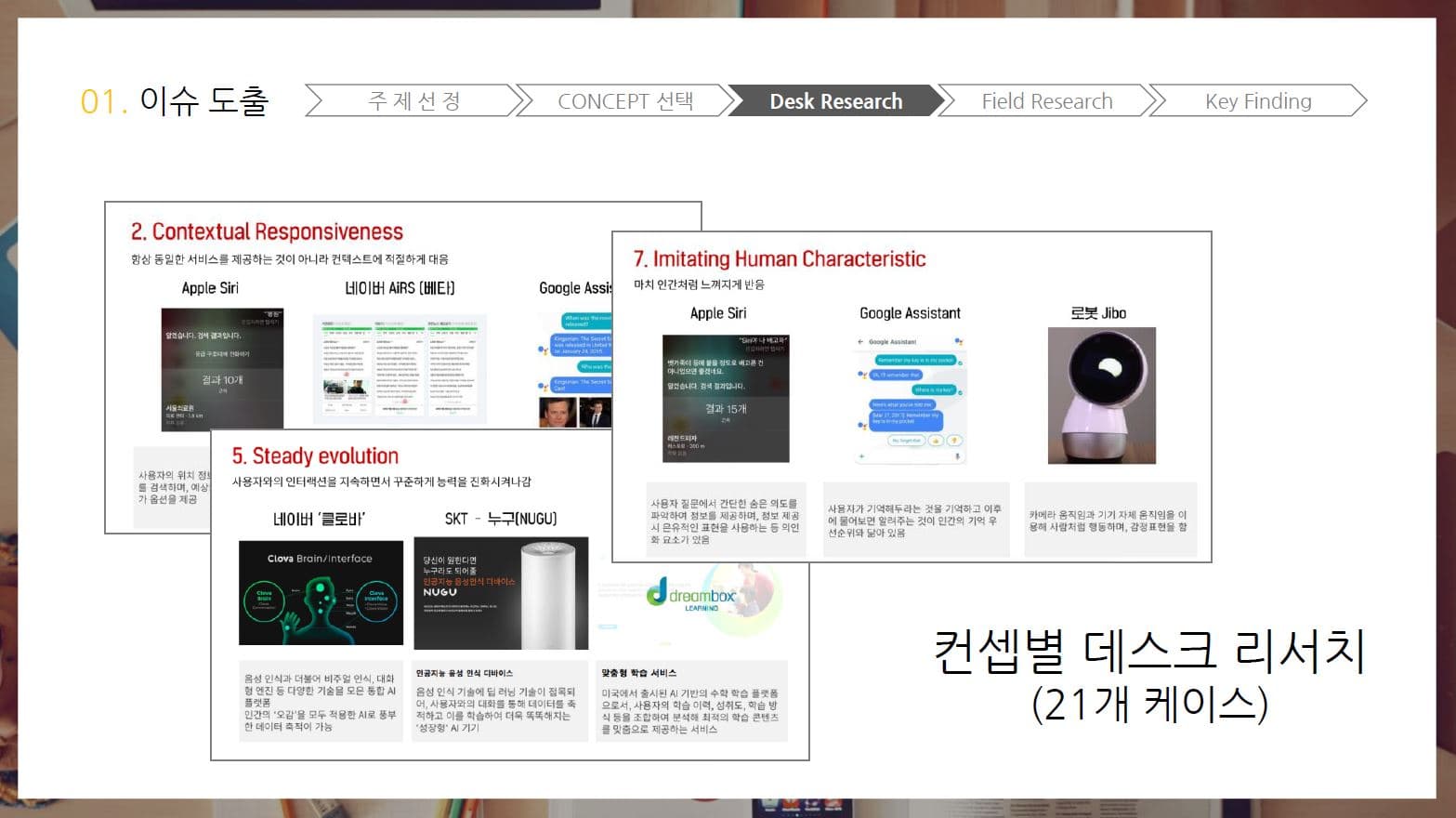
We walked the sequence: topic → concept → desk research → field research → key finding. First came desk research that dissected AI services by trait. There were 21 cases in total. We split examples like Siri, Naver AiRS, Google Assistant, Clova, SKT NUGU, and Jibo along axes such as Contextual Responsiveness, Steady Evolution, and Imitating Human Characteristic.
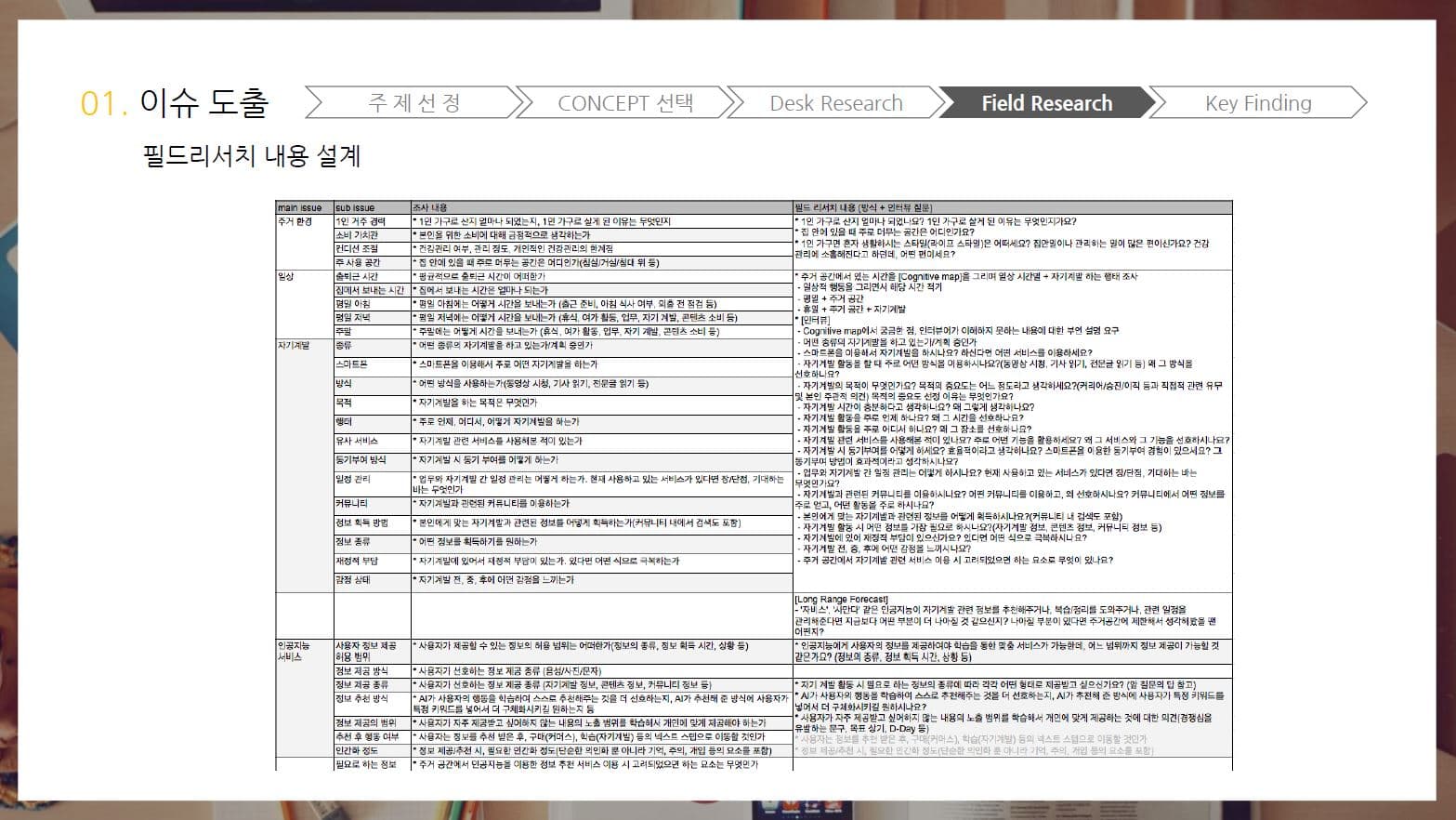
Next was designing the field research. We set the big issues: living environment, daily life, self-development, and AI services. For each sub-issue we paired a line of "what to investigate" with "the question we'd actually ask in the interview." Filling out that table was the first time I felt the density research really demands.
Concept — "a friend who gives emotional support"
Through research, we narrowed COACH's character to a "friend" who keeps you from losing sight of your goal, motivating you and supporting you emotionally too. Deciding the tone of the relationship before listing features was the right move.
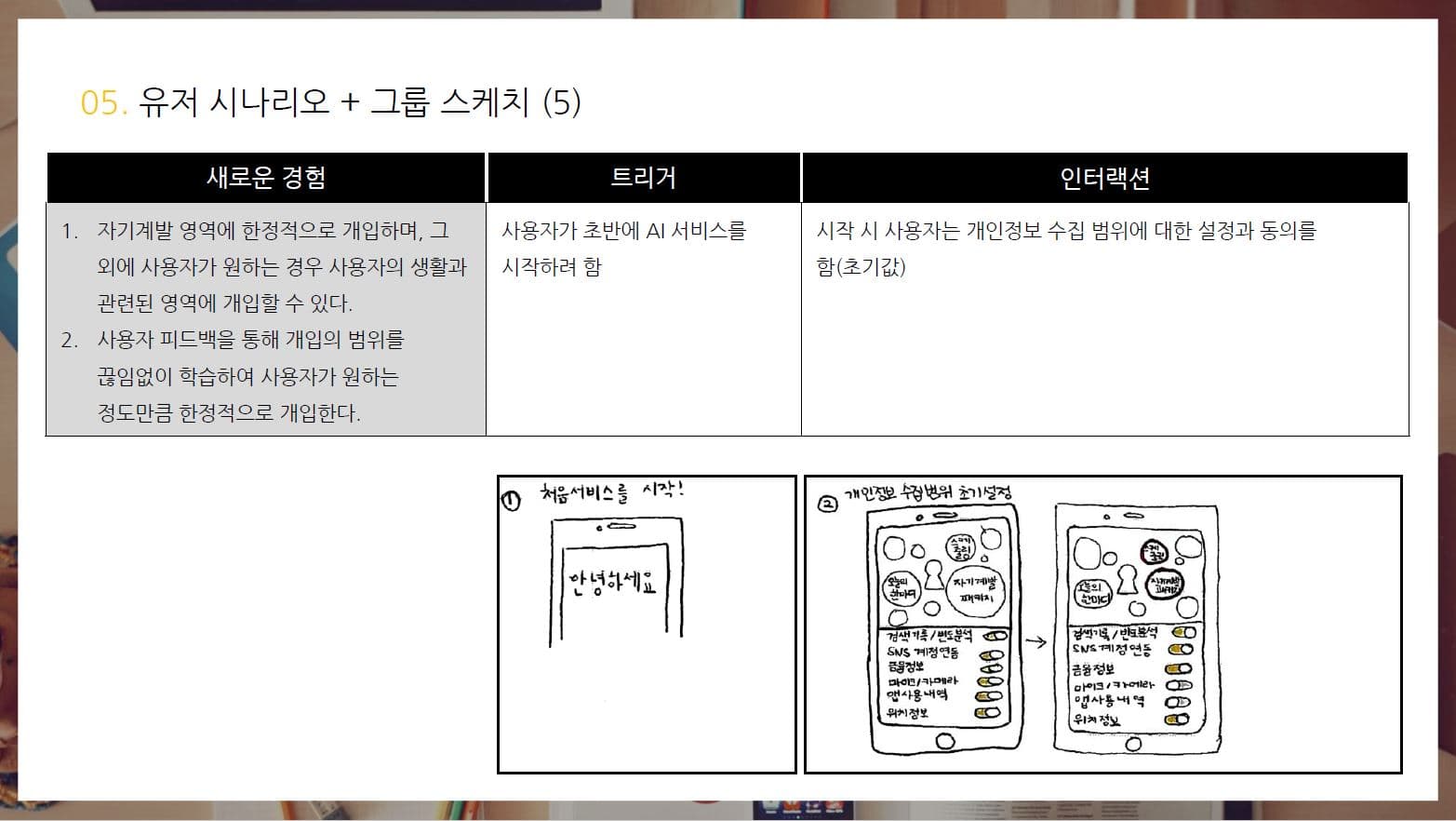
We also set a principle for how it intervenes. It steps in only within the self-development domain, and keeps learning from user feedback so it comes as close as "only as much as the user wants."
06. Prototyping
After framing scenarios with hand sketches, we moved them onto screens. Two flows were the core.
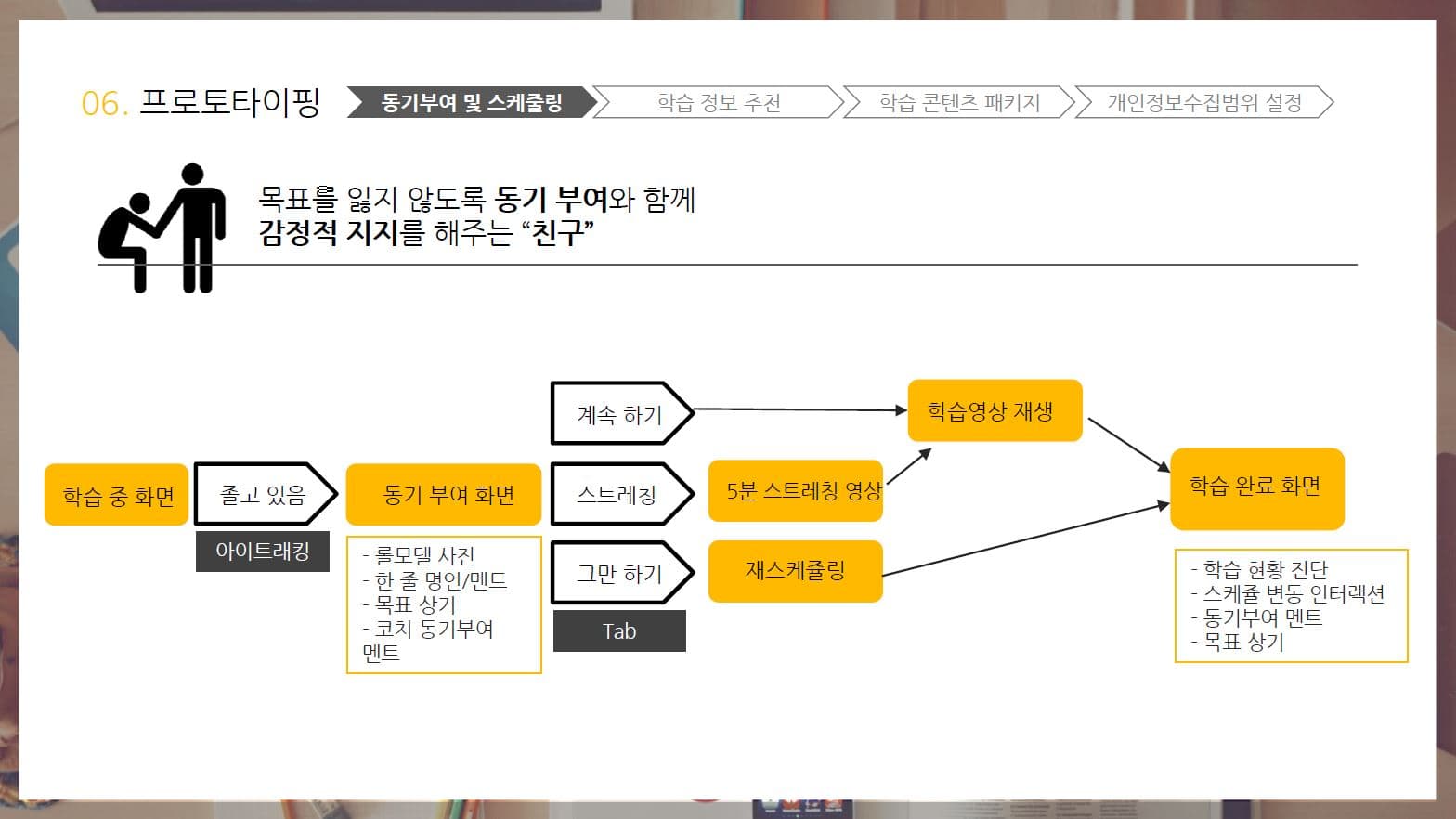
The first is motivation and scheduling. If eye-tracking detects that you're dozing off mid-study, a motivation screen appears. It shows a role-model photo, a one-line quote, a reminder of your goal, and a coach's message. You then pick keep going / stretch (5-min video) / stop (reschedule). Even if you stop, it doesn't scold; it just rebuilds your schedule.
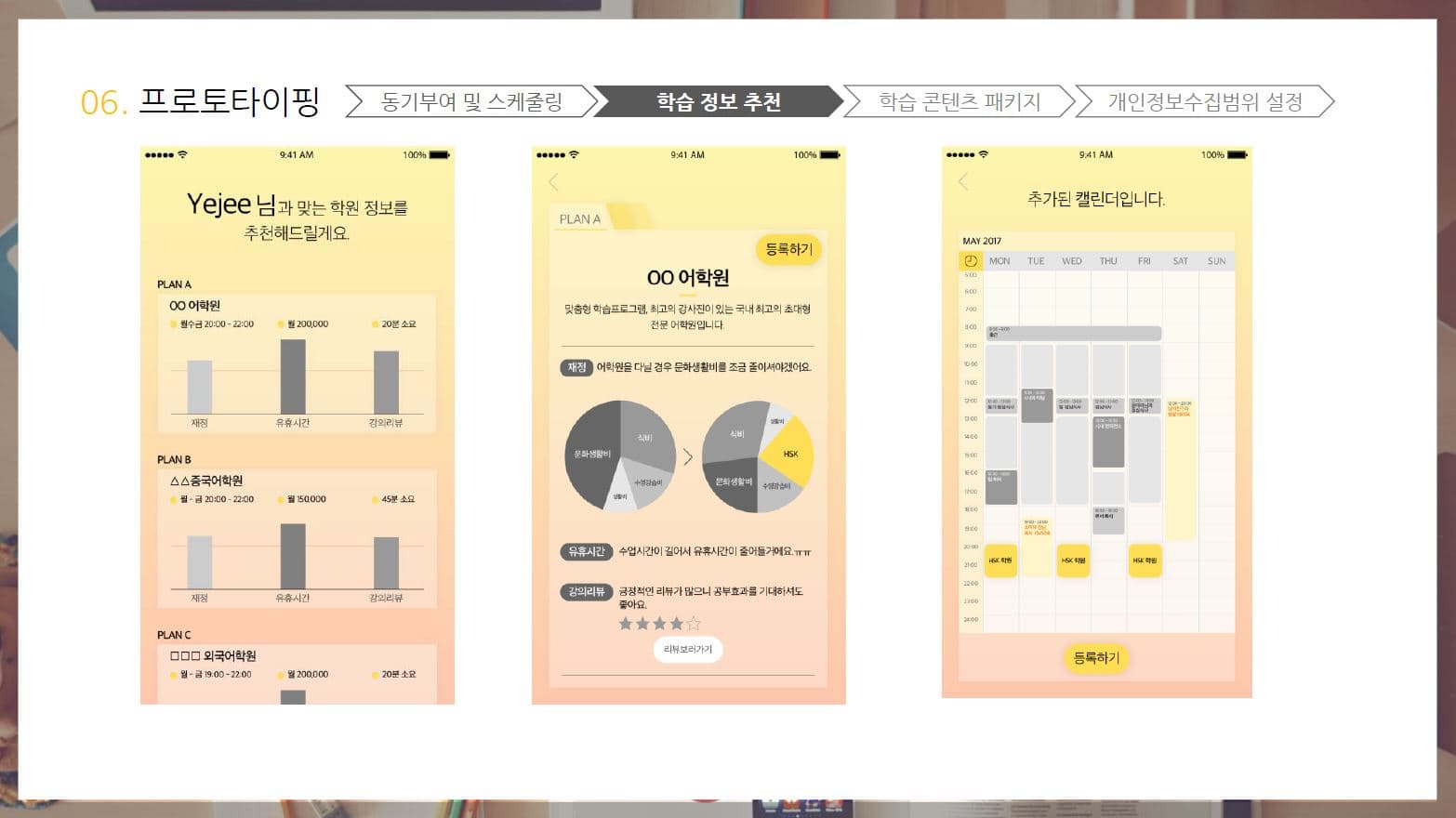
The second is learning recommendations. It compares academies that fit the user on budget, free time, and course reviews, and recommends them as PLAN A/B/C. Once you choose, it drops the study schedule straight onto your calendar.
Looking back
Key point
It's a 2017 output, rough by today's standards. Still, this is where I picked up the basic flow of UX: narrow the problem with research, set the concept's tone first, then come down into scenarios and screens. This project, built by six people staying late and earning us Best Team, was my first UX project.
Above all, being on a team with people this good was the real fortune of this project.