Overview
Personal project · Jul 2026– · Planning / development
It started from the question "What can we learn by collecting culture contents such as film, music, and books as data?" I built the whole thing solo, from collection to analysis and a dashboard. The first target is film (TMDB), but I designed a shared structure that extends to other domains from the start.
- Skill: data pipeline design, preprocessing, entity resolution, content-based recommendation, data visualization, product thinking
- Stack: Python (pandas·scikit-learn), PostgreSQL, TMDB API, rapidfuzz, matplotlib, Flask
Problem
Contents data is common, but rarely organized into a form you can analyze right away. Two things stood out.
- The same person is written inconsistently. Fail to merge "봉준호" / "Bong Joon-ho" / "Joon-ho Bong" and you can't even count "this director's filmography" correctly.
- Designing data anew per domain blocks expansion. Separate structures for film and music make later integration impossible.
Key point
The real problem of this project was "how do we organize and store the data" rather than the recommendation algorithm. I settled the structure before the model.
Solution
I designed the pipeline so data becomes analyzable through stages.
collect → raw store → preprocess(normalize/merge) → clean tables → analyze → dashboard
 TMDB    raw_payload        normalize/entity          work/person…   SQL+calc   Flask
First came the shared data model. Works, people, and relationships go in separate tables. Film or music, just change domain to fit the same structure.
work     -- shared info for a work (film/music/book…)
person   -- a person (a merged, canonical entity)
credit   -- work ↔ person relation (director/actor…)
metric   -- popularity/rating over time (source of trends)
Next is entity resolution, the spine of preprocessing. I merged the same person in three passes: same-source ID match, normalized-name match, and string similarity (rapidfuzz, threshold 92). Verified: Song Kang-ho appears in 5 films but is stored as exactly one person.
Recommendation was about turning plots into numbers. I combined genre/tag (word TF-IDF) with synopsis (Korean-friendly char n-gram TF-IDF) by weight, then picked similar works by cosine similarity.
combined = hstack([tag_mat * (1 - w), syn_mat * w]) # w = synopsis weight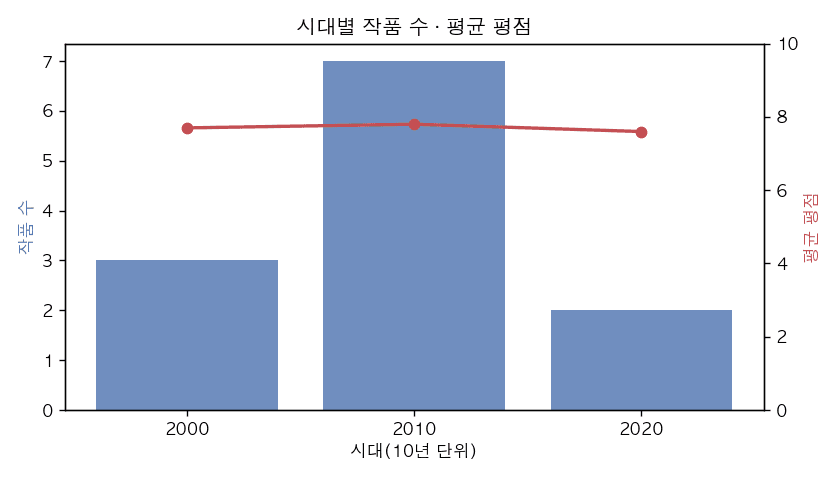
Result
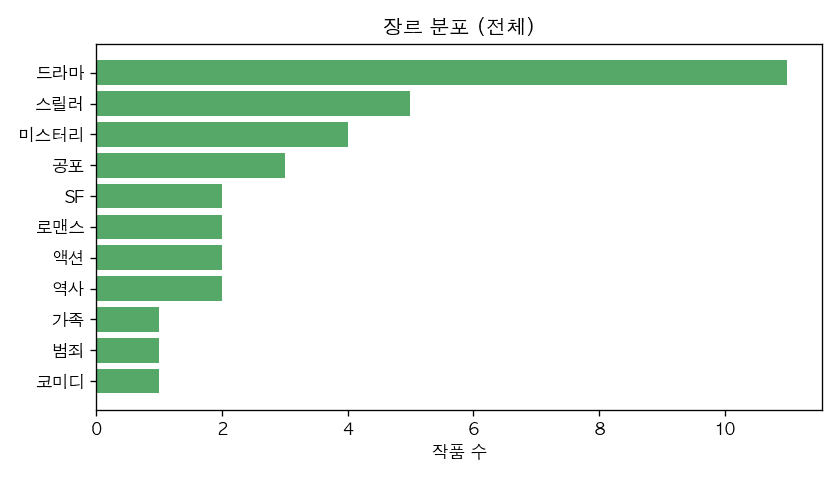
With 12 sample films, I verified that the entire flow of collection → preprocessing → analysis → visualization → dashboard works.
- For "Parasite," weighting the plot pushed the family drama "Minari" to the top at 0.143
- Trend shows rising popularity and genre shifts by year
- Era analysis compares counts, average rating, and runtime across the 2000s/2010s/2020s
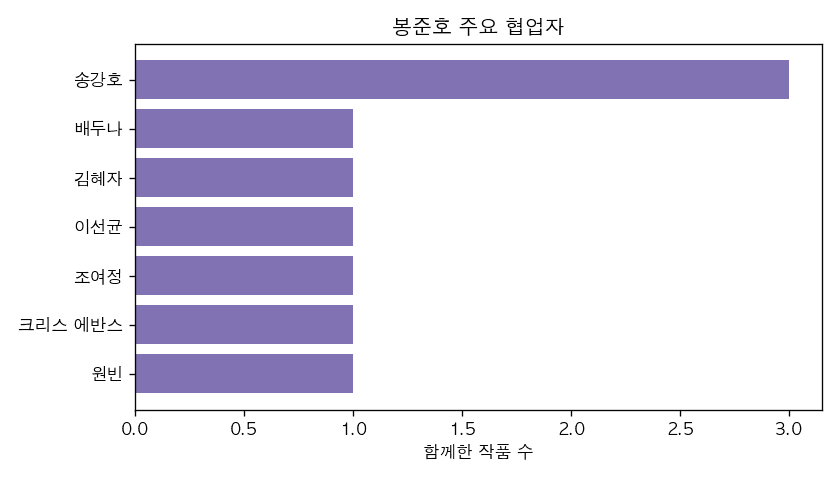
- Person analysis shows Bong Joon-ho's filmography of 4 films and top collaborators (Song, 3 times)
- The dashboard exposes the four results through Flask as a web UI and JSON API, and picking a film shows recommendations instantly as a bar chart
Connect a TMDB API key and it switches to real data just by swapping seed_sample.py for run_collect.py. The rest of the pipeline runs unchanged.
Retrospective
The recommendation algorithm itself was a few lines. The real work went into merging people into one entity (entity resolution) and designing tables reusable across domains. That foundation made it possible to attach a new domain like Spotify.
Storing the raw responses untouched let me reprocess without re-collecting when the logic changed. The data stayed a repeatable asset.
With only 12 sample films, statistical meaning is limited, and the recommender is content-based only. Connecting real data and adding collaborative filtering (from user logs) is the next task.